Testing Mind Map Series: How to Think Like a CRO Pro (Part 88)


Interview with Matthew Bass
There’s the experimentation everyone talks about. And then there’s how it actually happens.
We’re hunting for signals in the noise to bring you conversations with people who live in the data. The ones who obsess over test design and know how to secure buy-in even when results are complex.
They’ve built systems that scale. Weathered the failed tests. Convinced the unconvincible stakeholders.
And now they’re here: opening up their playbooks and sharing the good stuff.
This week, we’re chatting with Matthew Bass, Director of Optimization at Anatta.
Matthew, tell us about yourself. What inspired you to get into testing & optimization?
I’m the Director of Optimization at Anatta, where I lead UX strategy for high-growth eCommerce brands.
My background is in marketing, with deep experience in upper-funnel eCommerce acquisition and creative strategy. Over time, I became a strong proponent of data-informed UX performance, where I see experimentation as the bridge between intuition and truth, hypothesis and confirmation, and iteration and growth. Across high-growth eCommerce brands, I’ve scaled experimentation programs that connect qualitative insight, behavioral data, and commercial strategy into a single operating system for scalable performance.
Optimization pulled me in because it rewards curiosity and innovation. You’re constantly forming hypotheses about human behavior and then letting real users validate, or challenge, your assumptions. That connection between performance and empathetic user experience evolution is what ultimately hooked me.
How many years have you been testing for?
7+ years, starting in acquisition and creative testing, then expanding into full-funnel experimentation, UX research, and scaling enterprise optimization programs.
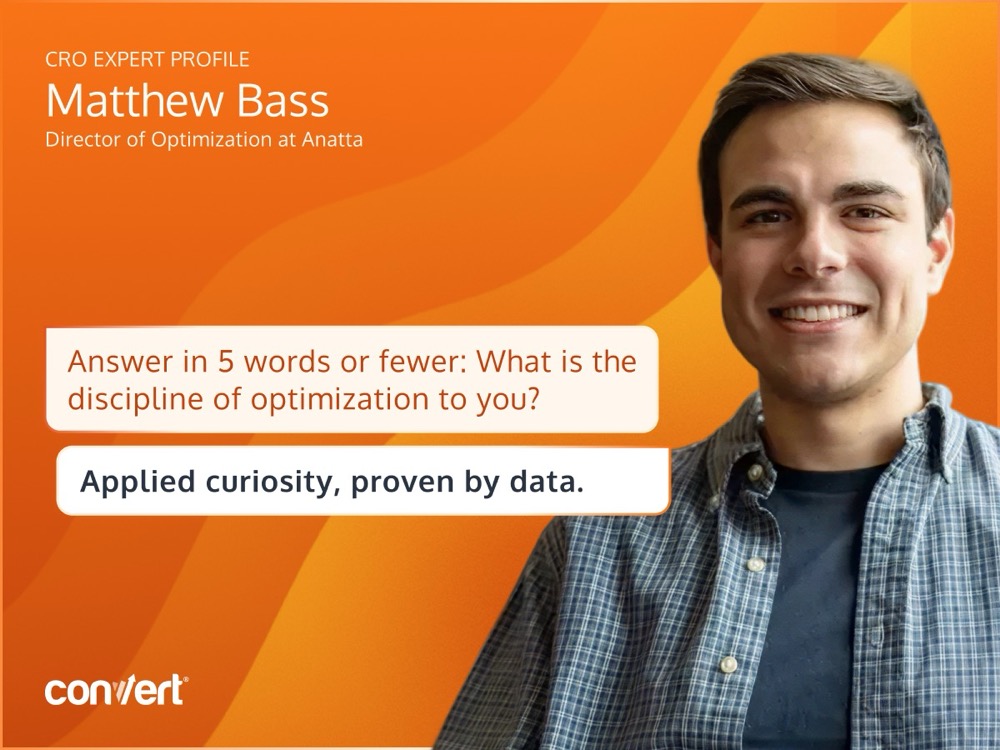
Answer in 5 words or less: What is the discipline of optimization to you?
Applied curiosity, proven by data
How is AI influencing your experimentation workflows?
AI accelerates how we synthesize thousands of data points across session recordings, survey responses, analytics, and merchandising behavior. It compresses what used to take days of analysis into hours. AI doesn’t replace strategic thinking. It increases the leverage of leaders who already know how to ask the right questions.
Concretely, we use AI to:
- Synthesize large volumes of qualitative & quantitative data into behavioral themes
- Prioritize initiatives by pressure-testing ideas against historical user data
- Identify gaps in thinking and surface untapped hypotheses based on user behavior patterns—and challenge assumptions using best practices as a baseline, not a conclusion.
You’ve had an interesting pivot: from creative strategy to CRO. What skills can creative strategy add to an experimenter’s toolkit?
Creative strategy trains you to think in narratives, not just metrics. It forces you to take a full-funnel approach to marketing and optimize for the user journey, not get lost in one specific touchpoint.
Experimenters with creative backgrounds tend to:
- Form stronger hypotheses rooted in motivation and intent, not UI preferences or strictly best practice usability guidelines
- Leverage an empathetic methodology in motivation and intent mapping
- Identify why a test won or lost, not just recognize that it did and move on
As experimentation matures, storytelling becomes essential because the insights uncovered are crucial to improving user experience across every touchpoint.
Where do you see optimizers in a year from today? Growth teams, product teams, still an independent unit?
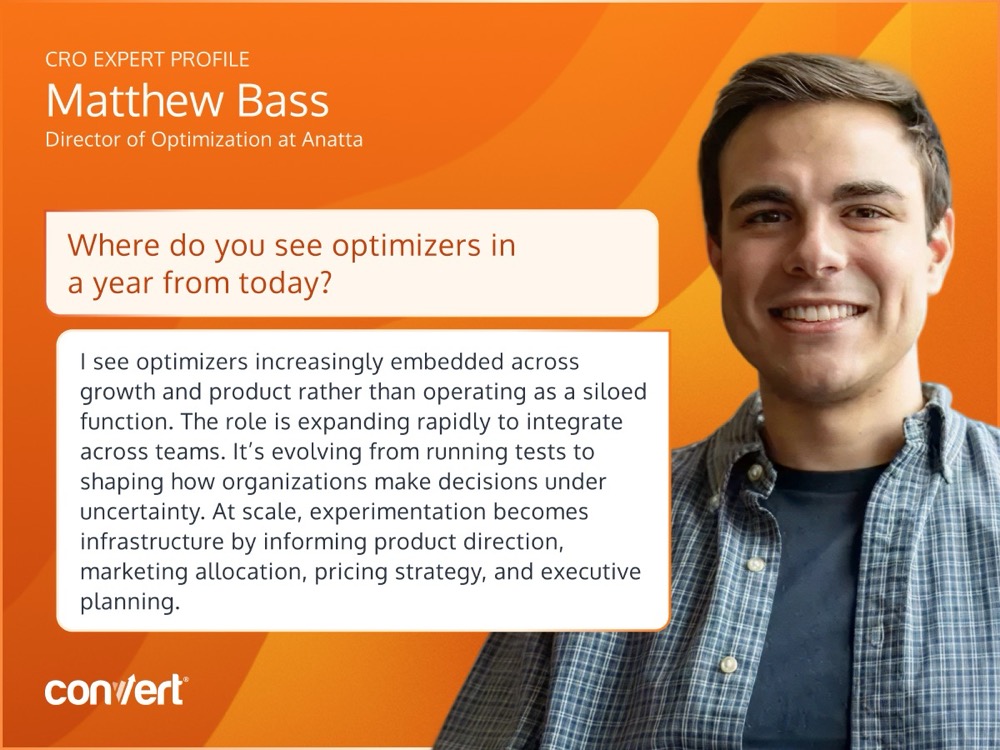
I see optimizers increasingly embedded across growth and product rather than operating as a siloed function.
The role is expanding rapidly to integrate across teams. It’s evolving from running tests to shaping how organizations make decisions under uncertainty.
At scale, experimentation becomes infrastructure by informing product direction, marketing allocation, pricing strategy, and executive planning.
The teams that understand this don’t just improve conversion rates. They build compounding competitive advantages over time that unlock exponential growth.
Talk to us about the unique experiments you’ve run over the years!
One of the most impactful experiments I’ve led reimagined the product detail page as a value-architecture system rather than a static merchandising layout.
Through behavioral and offer analysis, we discovered customers were highly motivated by an exclusive bundle — but it was buried outside the primary conversion path. The demand was there, the visibility was not.
We introduced a “Best Value” framing mechanism directly within the core PDP experience, making the bundle the most cognitively accessible option. By restructuring bundle prominence and clarifying price-per-unit economics inside the purchase flow, we reduced decision friction at the exact moment of commitment.
The result was a clear lift across key commercial metrics, while also protecting DTC channel revenue by positioning the bundle as a differentiated, direct-only offer.
More importantly, the test reshaped how the organization thinks about value communication and offer strategy across channels, informing omnichannel experience and future merchandising decisions beyond a single win.
Cheers for reading! If you’ve caught the CRO bug… you’re in good company here. Be sure to check back often, we have fresh interviews dropping twice a month. And if you’re in the mood for a binge read, have a gander at our earlier interviews with Gursimran Gujral, Haley Carpenter, Rishi Rawat, Sina Fak, Eden Bidani, Jakub Linowski, Shiva Manjunath, Deborah O’Malley, Andra Baragan, Rich Page, Ruben de Boer, Abi Hough, Alex Birkett, John Ostrowski, Ryan Levander, Ryan Thomas, Bhavik Patel, Siobhan Solberg, Tim Mehta, Rommil Santiago, Steph Le Prevost, Nils Koppelmann, Danielle Schwolow, Kevin Szpak, Marianne Stjernvall, Christoph Böcker, Max Bradley, Samuel Hess, Riccardo Vandra, Lukas Petrauskas, Gabriela Florea, Sean Clanchy, Ryan Webb, Tracy Laranjo, Lucia van den Brink, LeAnn Reyes, Lucrezia Platé, Daniel Jones, May Chin, Kyle Hearnshaw, Gerda Vogt-Thomas, Melanie Kyrklund, Sahil Patel, Lucas Vos, David Sanchez del Real, Oliver Kenyon, David Stepien, Maria Luiza de Lange, Callum Dreniw, Shirley Lee, Rúben Marinheiro, Lorik Mullaademi, Sergio Simarro Villalba, Georgiana Hunter-Cozens, Asmir Muminovic, Edd Saunders, Marc Uitterhoeve, Zander Aycock, Eduardo Marconi Pinheiro Lima, Linda Bustos, Marouscha Dorenbos, Cristina Molina, Tim Donets, Jarrah Hemmant, Cristina Giorgetti, Tom van den Berg, Tyler Hudson, Oliver West, Brian Poe, Carlos Trujillo, Eddie Aguilar, Matt Tilling, Jake Sapirstein, Nils Stotz, Hannah Davis, Jon Crowder, Mike Fawcett, Greg Wendel, Sadie Neve, Cristina McGuire, Richard Joe, Ruud van der Veer, Merritt Aho, Felipe Henrique Fogarolli, Riccardo Oricchio, Bruno Borges, and Daniel Mullins.

Written By
Matthew Bass
Edited By
Carmen Apostu