Testing Mind Map Series: How to Think Like a CRO Pro (Part 92)


Interview with Katie Faulkner
There’s the experimentation everyone talks about. And then there’s how it actually happens.
We’re hunting for signals in the noise to bring you conversations with people who live in the data. The ones who obsess over test design and know how to secure buy-in even when results are complex.
They’ve built systems that scale. Weathered the failed tests. Convinced the unconvincible stakeholders.
And now they’re here: opening up their playbooks and sharing the good stuff.
This week, we’re chatting with Katie Faulkner, Optimisation Strategist at FORJ Digital and the latest winner of SpeakUp to Uplevel, our annual competition with Women in Experimentation.
Katie, tell us about yourself. What inspired you to get into testing & optimization?
It was a happy accident that I ended up in CRO. I knew I wanted to work in digital marketing early on in my career, but I didn’t know where I fit in yet. I applied for a generalist job at a local agency, and I was lucky that my application got to someone who took the time to look at my background, which included science, data, art, and customer service, to help me figure out where I would fit in best. She told me to look into CRO, saying that it might be the field that could tie all those threads together. As soon as I started looking into it, I was hooked. I got the job, worked hard at it, and never looked back.
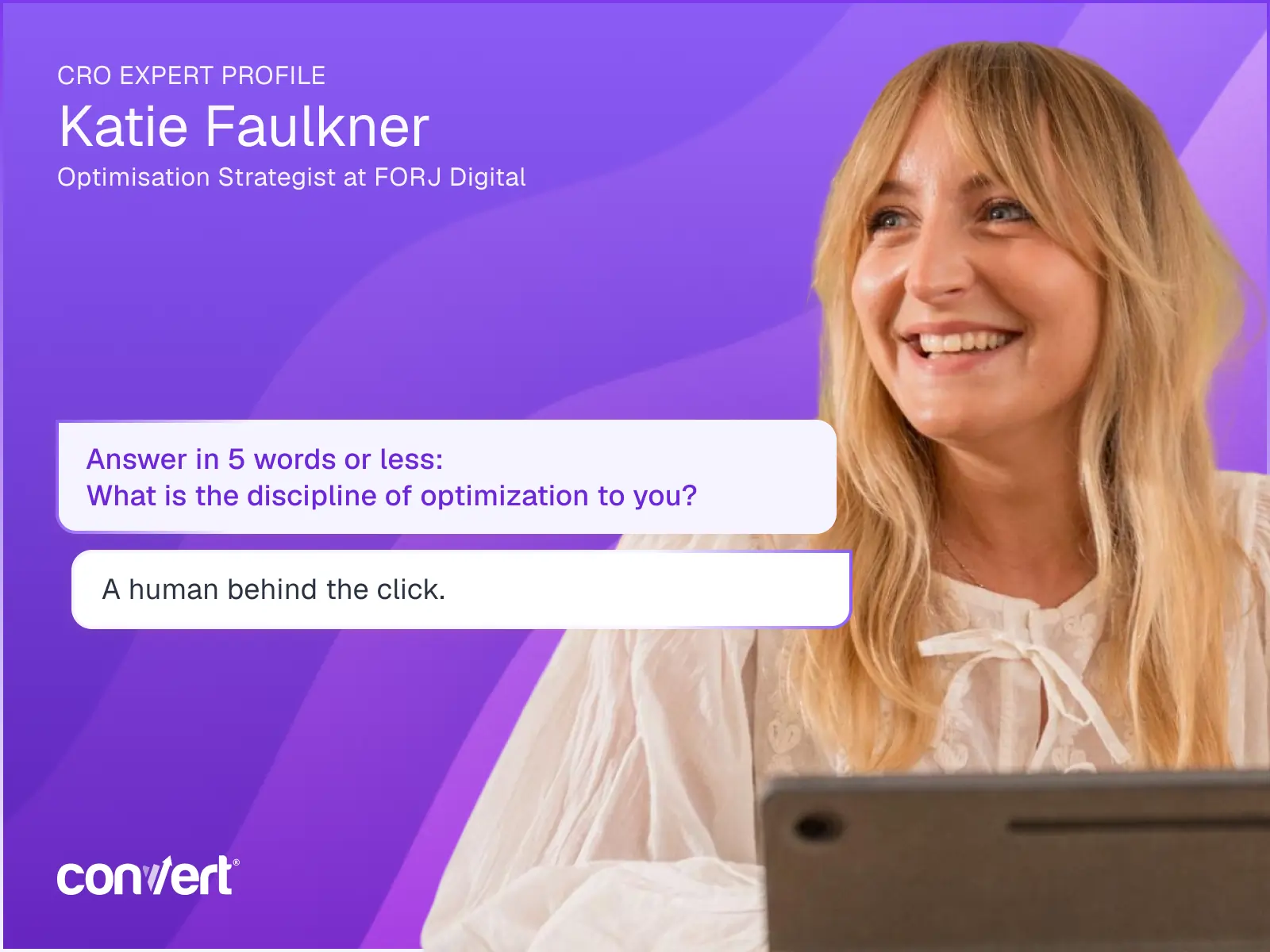
Answer in 5 words or less: What is the discipline of optimization to you?
A human behind the click.
How is AI influencing experimentation for you? How do you think about incorporating AI in your workflows?
In real life, we treat AI like a member of our team. We’ll give an agent a job to do, like making a report, analysing raw qualitative data, or turning research insights into a wireframe. While the agent is doing that, we’ll be doing it too. We meet halfway. Sometimes it gives us a new angle or design direction that we wouldn’t have thought of on our own, which is very helpful.
I really believe that diverse minds do the best work. The best ideas come from groups of people with different backgrounds, points of view, and ways of looking at a problem. I think AI should be on that list of minds. But that’s the important word: one of those minds, not the mind. You lose the meaning of the work and the soundness of the strategy as soon as you completely hand over your thinking to it.
For now, AI is a colleague for me, and like any colleague, it works best when it’s part of a team that knows how to work best with it.

Where are CRO & experimentation headed? And why? How can practitioners adjust?
What I find most exciting is when AI goes beyond the testing platform. I think we’ll see it built right into browsers and websites, where it can predict what users will do in real time even before a page fully loads. I think the logical end point of that is web pages that don’t load as a set template at all, but instead build themselves module by module based on how people act. Your past, present, and future all affect what experiences are served to you in real time. The page is the experiment at that point, always and invisibly getting better. You can already see signs of this on some testing platforms where you can trigger A/B tests based on behavioural signals.
But I want to be honest: I think anyone who says they know exactly where AI is going is being too sure of themselves. We are all in learning mode right now, so we don’t know for sure. The technology is moving faster than the rules we have for using it, and I think the best way to deal with this is to be curious instead of confident.
Talk to us about the unique experiments you’ve run over the years.
I love the experiments that come from companies with complicated business models the most. These are the ones where customers have a hard time finding what they need because there are so many different ways to get there. That’s where I think CRO can really shine.
One thing I’ve looked into is making conversational, dynamic journeys that are like what a good shop assistant does in person. Instead of letting a customer figure out a complicated site structure on their own, you help them through it. You ask the right questions, listen to the answers, and bring up what’s really important to them. In theory, it’s easy, but in practice, it changes everything.
I recently made a budget planner for an amusement park where people often didn’t plan for costs they didn’t expect on the day. People’s expectations and what they actually got were not the same, which hurt trust and satisfaction. Making the online experience honest and helpful instead of just transactional really helped close the gap.
The most interesting problems to solve are those that happen in the space between the online and in-person experience. It makes you see the customer as a real person with their own worries and needs, not just a piece of data going through a funnel. This is one of the easiest but most important things to remember.
I get a lot of unique ideas from the world of experimentation outside of my own work. On AO’s site, when you copy a product serial number the comparison pop-up that appears is a great example of behavioural thinking. Charlotte Tilbury’s shade finder really does help with a problem that used to only be able to be solved in person. Anybody who wears makeup will tell you that. And instead of sorting by price or popularity, Sézane sorts their PLP by colour. This may seem simple, but it’s a smart move for a luxury brand like theirs. It makes filtering unnecessary, lowers cognitive load, and turns browsing into a discovery. It works great with the size of their product catalogue, with each colour group only lasting a few scrolls on mobile, so the whole experience is easy instead of overwhelming.
There are so many creative things you can do in this field. It’ll be great to see what optimisation teams come up with using AI.
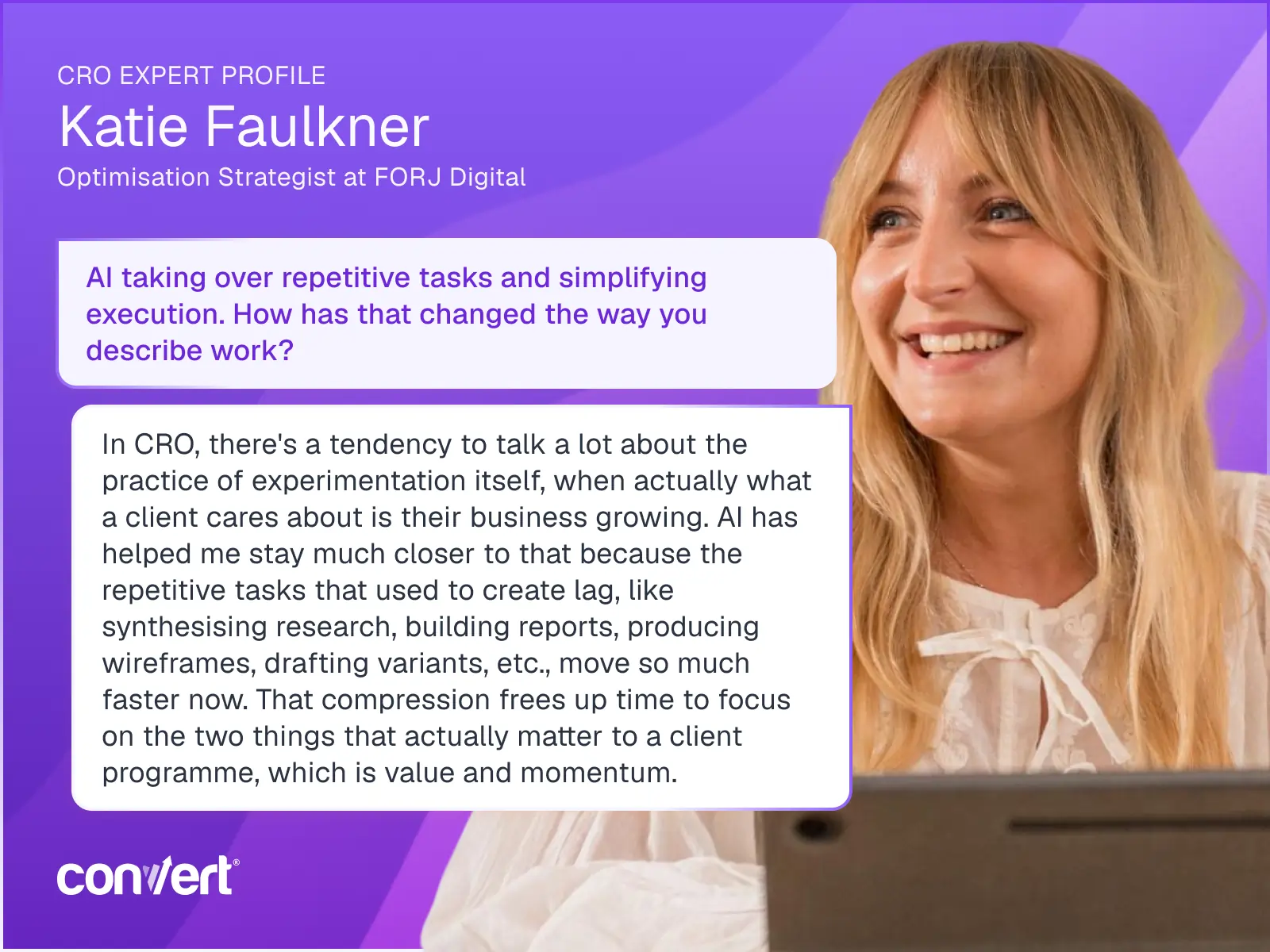
AI taking over repetitive tasks and simplifying execution. How has that changed the way you describe work?
What it’s really changed is where my team and I spend our energy and, more importantly, what it’s meant for clients.
In CRO, there’s a tendency to talk a lot about the practice of experimentation itself, when actually what a client cares about is their business growing. AI has helped me stay much closer to that because the repetitive tasks that used to create lag, like synthesising research, building reports, producing wireframes, drafting variants, etc., move so much faster now. That compression frees up time to focus on the two things that actually matter to a client programme, which is value and momentum.
Value, because you’re spending more time on strategic thinking and stronger hypotheses rather than production. Momentum, because the time between getting an idea and putting it into action has gotten a lot shorter. Things that used to take days now only take minutes, if not seconds. Clients definitely notice. A programme that moves quickly and which clearly shows value builds trust, and that is what gives you the freedom to run more bold and ambitious experiments. What matters here is the quality of your prompts, which determine the quality of the output, of course.
So, I would say that work is less about the process and more about the effect now. AI has made execution easier, so instead of saying “here’s what we’re doing,” we now focus more on “here’s what it means for your business.” This is a much better conversation to have.
You’ve recently won quite a few awards and accolades. How can experimenters build credible visibility in 2026?
To be honest, I’ve always had a little bit of imposter syndrome, so it takes me a while to get used to being recognised like this. But 2026 has been a very important year for my career. The only thing that has changed is that I’ve been more aware of how important it is to build relationships.
That hasn’t come from a desire for awards or attention, it’s come from a real desire to build community within CRO. It’s a pretty niche field, and there aren’t many of us in Shropshire, so it was important to find and connect with people who care about the same things. It has been really energising.
I think it’s very important to be open and honest about how you see things, talk to other people, and learn from them. We all deal with problems in different ways because of our experiences and how our brains are wired. I think that’s where the best conversations come from. Don’t be afraid to say what you think or to do things the way that works best for you. For example, I like to sit back and think about things before I act. I don’t often speak up first in meetings, and I’ve never said sorry for it because that’s how I think more clearly and do my best work. That’s how I talk at a conference, on LinkedIn, or anywhere else. It goes against the grain of the understanding that “getting yourself heard” is through speed or volume, but instead through the quality of what you have to say as a result of allowing yourself to think more deeply.
If you want to build credibility in 2026, the best thing you can do is be human. You don’t have to show off your confidence or skills. Talk about what really interests you, what motivates you, and what makes you happy. It will probably also light other people’s fires. People remember that authenticity, and that’s what sticks with them.
Cheers for reading! If you’ve caught the CRO bug… you’re in good company here. Be sure to check back often, we have fresh interviews dropping twice a month.
And if you’re in the mood for a binge read, have a gander at our earlier interviews with Gursimran Gujral, Haley Carpenter, Rishi Rawat, Sina Fak, Eden Bidani, Jakub Linowski, Shiva Manjunath, Deborah O’Malley, Andra Baragan, Rich Page, Ruben de Boer, Abi Hough, Alex Birkett, John Ostrowski, Ryan Levander, Ryan Thomas, Bhavik Patel, Siobhan Solberg, Tim Mehta, Rommil Santiago, Steph Le Prevost, Nils Koppelmann, Danielle Schwolow, Kevin Szpak, Marianne Stjernvall, Christoph Böcker, Max Bradley, Samuel Hess, Riccardo Vandra, Lukas Petrauskas, Gabriela Florea, Sean Clanchy, Ryan Webb, Tracy Laranjo, Lucia van den Brink, LeAnn Reyes, Lucrezia Platé, Daniel Jones, May Chin, Kyle Hearnshaw, Gerda Vogt-Thomas, Melanie Kyrklund, Sahil Patel, Lucas Vos, David Sanchez del Real, Oliver Kenyon, David Stepien, Maria Luiza de Lange, Callum Dreniw, Shirley Lee, Rúben Marinheiro, Lorik Mullaademi, Sergio Simarro Villalba, Georgiana Hunter-Cozens, Asmir Muminovic, Edd Saunders, Marc Uitterhoeve, Zander Aycock, Eduardo Marconi Pinheiro Lima, Linda Bustos, Marouscha Dorenbos, Cristina Molina, Tim Donets, Jarrah Hemmant, Cristina Giorgetti, Tom van den Berg, Tyler Hudson, Oliver West, Brian Poe, Carlos Trujillo, Eddie Aguilar, Matt Tilling, Jake Sapirstein, Nils Stotz, Hannah Davis, Jon Crowder, Mike Fawcett, Greg Wendel, Sadie Neve, Cristina McGuire, Richard Joe, Ruud van der Veer, Merritt Aho, Felipe Henrique Fogarolli, Riccardo Oricchio, Bruno Borges, Daniel Mullins, Matthew Bass, Pieter Boonstra, Simbar Dube, and Dzifa Mensah.

Written By
Katie Faulkner
Edited By
Carmen Apostu