Testing Mind Map Series: How to Think Like a CRO Pro, Part 98 with Delphine Finders-Binje

Delphine Finders-Binje is the latest expert to open up their playbook for our Testing Mind Map series. These interviews look past the tidy version of experimentation and into the day-to-day: how evidence fares against conviction, which test wins survive contact with production, and where judgment sits now that AI has commoditized execution.
Delphine, tell us about yourself. What inspired you to get into testing & optimization?
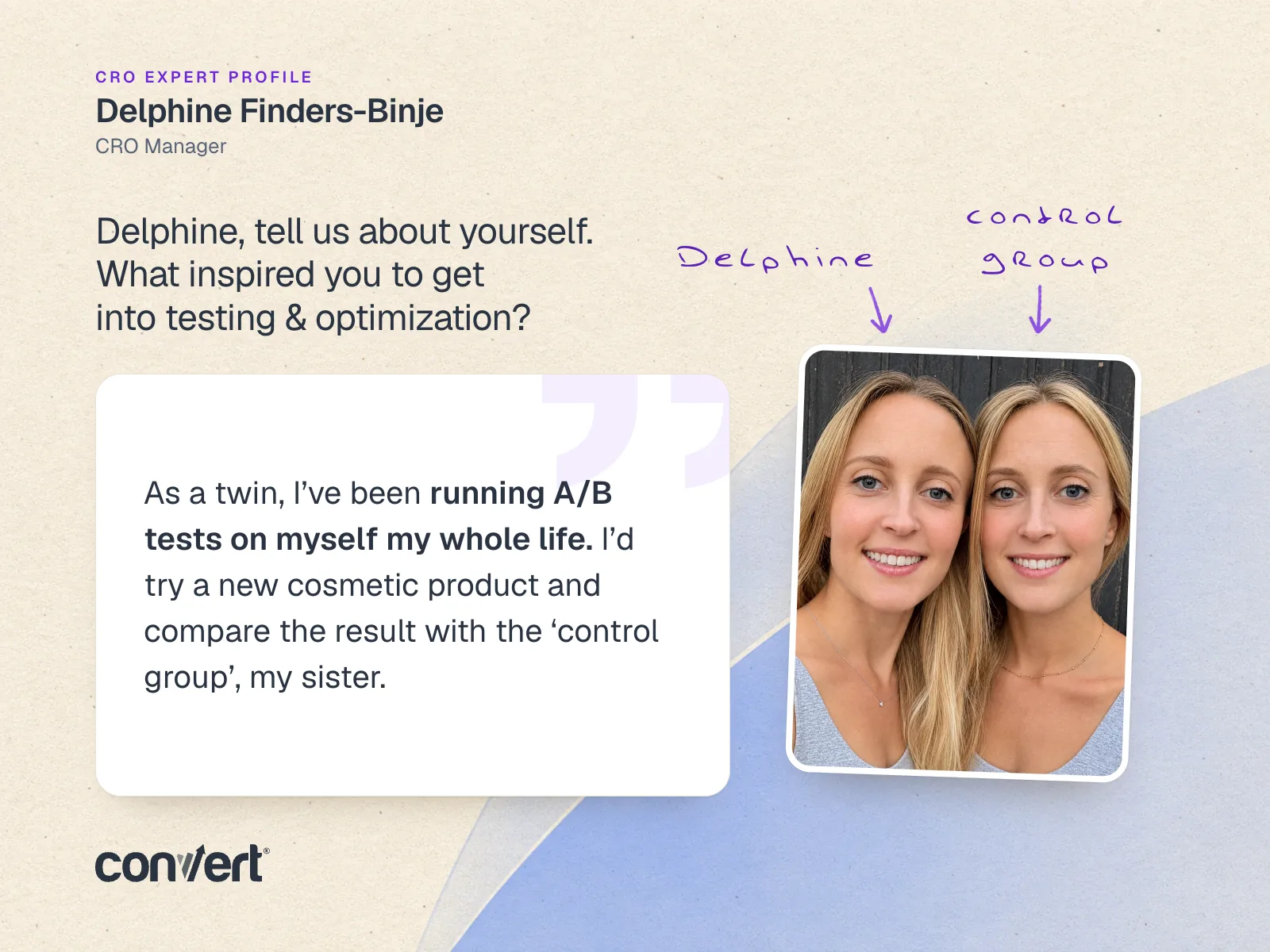
I am Delphine Finders-Binje and I did not choose experimentation. I grew up in it. I have been running experiments for 32 years, which, yes, also happens to be my age. As a twin, I’ve been running A/B tests on myself my whole life. I’d try a new cosmetic product and compare the result with the ‘control group’, my sister. It was totally biased and far from statistical, but that’s how it all started. The comparisons were not made to judge each other, but with an aim to optimize.
I always knew I wanted to end up in marketing and was pretty convinced I didn’t want to work on the digital side of it. I was more into posters and commercials. I guess my father being a developer nudged me towards the digital side after all.
During my internship, I was introduced to an A/B testing tool, and suddenly it all made sense. I found a field where I could use my analytical mindset, my appetite for creativity and customer psychology, my attention to detail and, above all, my ‘inspector-of-finished-work’ skills, as they called it. When I discovered that comparing, learning and iterating was an actual profession, it felt inevitable.
Answer in 5 words or less: What is the discipline of optimization to you?
Facts above opinions
How is AI influencing experimentation for you? How do you think about incorporating AI in your workflows?
For me, AI isn’t good or bad, it’s like a ball. You can play football with it, basketball or any other ball sport. The difference is the purpose you give it.
After analyzing how it worked and the risks involved, I decided to integrate it into some flows. Nowadays, it analyzes my results, reads my test details, checks my test screenshots, and even reviews my previous test iterations. Based on all of that, it suggests recommendations tailored to each stakeholder’s profile. A report for a web analyst contains more figures, while one for a product manager focuses more on outcomes and general learnings to share.
I believe we are only at the beginning of how AI can help us make our work better and more efficient. I would not fight against it, but learn how to understand and integrate it.
AI should be used as a tool, not a colleague. It doesn’t take away ownership and accountability. You still have to approve and validate before sending anything out.
Where are CRO & experimentation headed? And why? How can practitioners adjust?
While some companies still focus on running a few impactful tests, there is generally a higher appetite for speed in execution. Both from agencies and from clients. This requires rigor in documentation and processes, as they fuel AI and automations.
Some tasks are being ‘taken over’ by AI, or, as I prefer to put it, ‘offloaded’. Those are mainly execution-focused. In my opinion, humans will still be needed for judgment and strategy. If the integration of AI is done correctly, we should be able to focus more on tasks where we bring high value.
When companies first adopted the internet, a lot of jobs became redundant. You can look at that part of the story and blame it, or admit that many other jobs were created too. It’s all a matter of adjusting, understanding the needs and keeping our energy to adapt instead of fighting against it.
Talk to us about the unique experiments you’ve run over the years:
I’ve run over 250 A/B tests and, while not all of them had a positive lift, every one of them brought interesting learnings.
One test I come back to often demonstrates that the objective is not to personalize everything, but to do it in the right way.
A grocery e-commerce platform showed a cross-sell carousel with the top offers on its homepage. They wanted to replace it with relevant products instead of a generic collection. It turned out that revenue per visitor dropped by 5%. We knew it was not due to removing the first carousel, as the interaction on it was minimal. Further analysis and iterations demonstrated that the design and logic of the products displayed were fine. It was the so-called ‘creep factor’ that created the negative impact. It is a textbook case of how personalization can backfire. When it makes the visitor feel watched rather than helped, it works against you. The title “Products from your last order” was too intrusive. The next iteration obtained a lift of 4% in revenue per visitor. The change? We simply removed the title!
Last but not least, AI taking over repetitive tasks and simplifying execution. How has that changed the way you describe work?
As AI and automations take over repetitive tasks, we freed up some time to … build more integrations. Some of the tasks that used to involve copy-pasting information and basic analysis shifted toward more technical work. We advocate for the optimization of websites, so we have to optimize our processes too.
By integrating AI and automation into my workflows, I was able to save 16 hours for a medium-sized customer per testing period. This represents $35,000 in value that can be invested in their strategy or in higher testing velocity.
Cheers for reading! If you’ve caught the CRO bug… you’re in good company here. Be sure to check back often, we have fresh interviews dropping twice a month.
And if you’re in the mood for a binge read, have a gander at our earlier interviews with Gursimran Gujral, Haley Carpenter, Rishi Rawat, Sina Fak, Eden Bidani, Jakub Linowski, Shiva Manjunath, Deborah O’Malley, Andra Baragan, Rich Page, Ruben de Boer, Abi Hough, Alex Birkett, John Ostrowski, Ryan Levander, Ryan Thomas, Bhavik Patel, Siobhan Solberg, Tim Mehta, Rommil Santiago, Steph Le Prevost, Nils Koppelmann, Danielle Schwolow, Kevin Szpak, Marianne Stjernvall, Christoph Böcker, Max Bradley, Samuel Hess, Riccardo Vandra, Lukas Petrauskas, Gabriela Florea, Sean Clanchy, Ryan Webb, Tracy Laranjo, Lucia van den Brink, LeAnn Reyes, Lucrezia Platé, Daniel Jones, May Chin, Kyle Hearnshaw, Gerda Vogt-Thomas, Melanie Kyrklund, Sahil Patel, Lucas Vos, David Sanchez del Real, Oliver Kenyon, David Stepien, Maria Luiza de Lange, Callum Dreniw, Shirley Lee, Rúben Marinheiro, Lorik Mullaademi, Sergio Simarro Villalba, Georgiana Hunter-Cozens, Asmir Muminovic, Edd Saunders, Marc Uitterhoeve, Zander Aycock, Eduardo Marconi Pinheiro Lima, Linda Bustos, Marouscha Dorenbos, Cristina Molina, Tim Donets, Jarrah Hemmant, Cristina Giorgetti, Tom van den Berg, Tyler Hudson, Oliver West, Brian Poe, Carlos Trujillo, Eddie Aguilar, Matt Tilling, Jake Sapirstein, Nils Stotz, Hannah Davis, Jon Crowder, Mike Fawcett, Greg Wendel, Sadie Neve, Cristina McGuire, Richard Joe, Ruud van der Veer, Merritt Aho, Felipe Henrique Fogarolli, Riccardo Oricchio, Bruno Borges, Daniel Mullins, Matthew Bass, Pieter Boonstra, Simbar Dube, Dzifa Mensah, Katie Faulkner, Andrea Bronzini, Sanne Maach Abrahamsson, Craig Kistler, Buse Hizarci, and David Dias Rodríguez.

Written By
Delphine Finders-Binje

Edited By
Carmen Apostu