Full-Stack vs Server-Side Experimentation: What’s the Difference?


Some testers use full-stack and server-side interchangeably, but they’re different.
- Server-side testing is a method where your server or app code selects the variation before any content reaches the user.
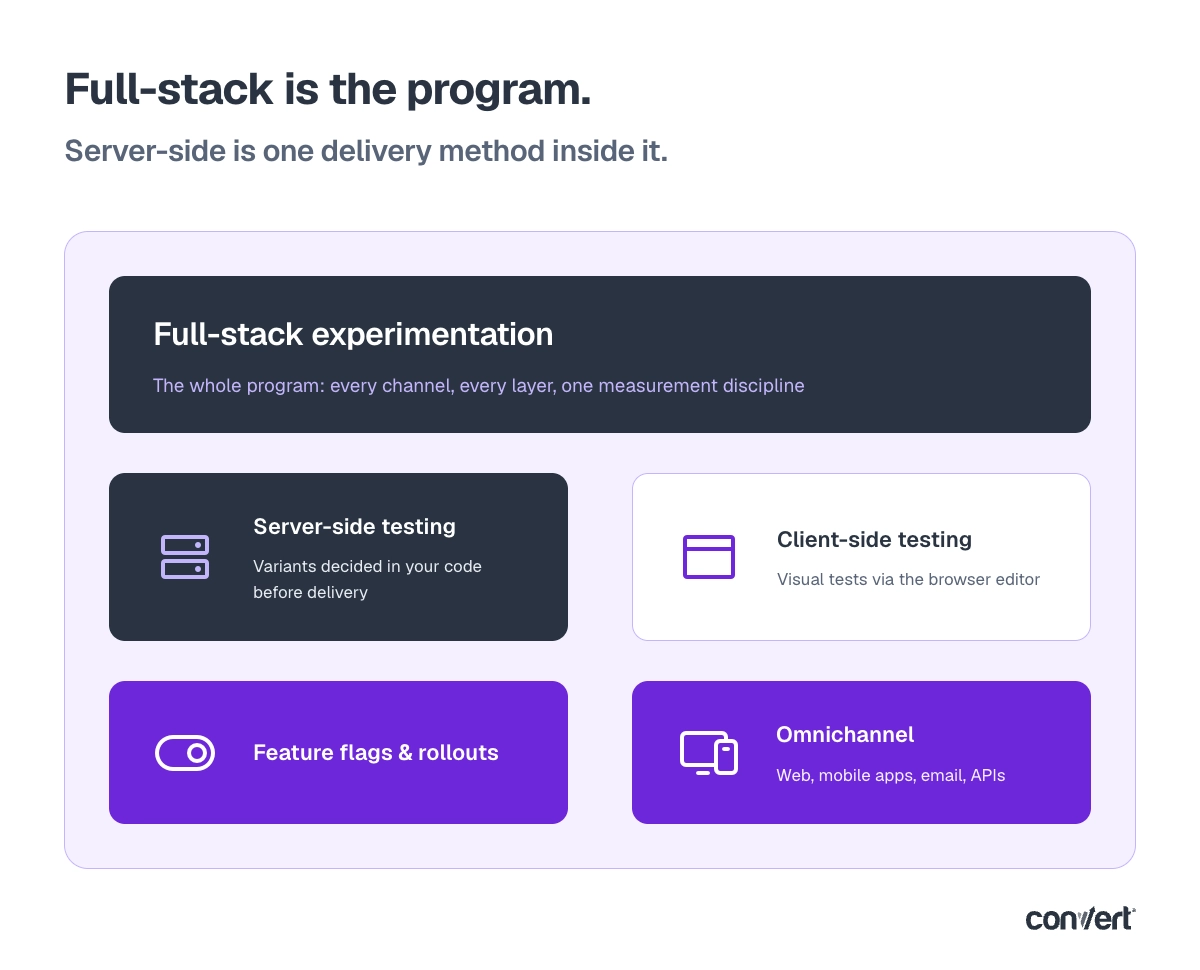
- Full-stack experimentation is a program that covers client-side tests, server-side tests, feature flags, and every channel you ship to.
- “Full Stack” was popularized in 2016. Vendors now sell the same capability as Feature Experimentation or Fullstack.
- Convert Experiences runs both server-side and full-stack experimentation.
Is server-side testing the same as full-stack experimentation?
While both are related, they aren’t the same. In this article, we’ll dig into their differences so you can confidently choose the right one for your team and ask vendors the right questions.
What Is Server-Side Testing?
Server-side testing is a way of running tests where your server or your application’s code chooses the variation before any content reaches the user’s screen. Your user’s browser or app receives the finished experience, so nothing visibly swaps on their screen after the page loads.
Here’s how it works:
- An SDK inside your backend or app loads the experiment settings. It checks which tests are live, who qualifies, and how traffic splits.
- When a request arrives (a user visits your website or logs into your app), your code passes the SDK a visitor ID and asks which variation to serve.
- The SDK hashes that ID and returns the same variation every time for that visitor, as long as the test’s traffic split stays the same.
- Your code renders the variation, and the SDK reports the exposure and any later conversions to the testing platform.
Server-side works best for tests involving:
- Backend logic, for example, search ranking, recommendation models, checkout rules.
- Pricing and offers. The price has to match on the product page, in the cart, and on the invoice, so the change has to go to the primary source in the web or app code.
- Account-dependent features such as plan limits, paid-feature access, and anything behind a login that relies on backend records.
- Single-page applications (AKA SPAs, which are React, Vue, and Angular apps that render in the browser after load, e.g., YouTube and Netflix in your browser).
- Mobile apps. Since native iOS and Android screens have no page to inject a script into, server-side testing does the job.
Server-side testing has its perks, but one trade-off is engineering time. Unlike client-side tests that are mostly easy for non-devs to set up with visual editors, server-side testing requires each variation to ship as code. So it waits for the same review, testing, and deployment as any other change, and your team builds the tracking that measures it.
What Is Full-Stack Experimentation?
Full-stack experimentation is a way of testing that spans every layer your team ships. That includes web pages, backend logic, APIs and native apps, and they’re all measured under one discipline. Server-side testing is one delivery method inside that program.
A full-stack program usually includes:
- Client-side tests on web pages (think: headlines, layouts, CTAs), built in a visual or code editor.
- Server-side tests on backend logic, pricing, and APIs (as we’ve covered above).
- Feature flags and rollouts, which release a change to a share of users and widen it as the data gathered informs the tester.
- Omnichannel tests across web, mobile apps, email and APIs, where one visitor sees the same variation on every channel.
Where the Term “Full Stack” Came From (and Why It’s Confusing)
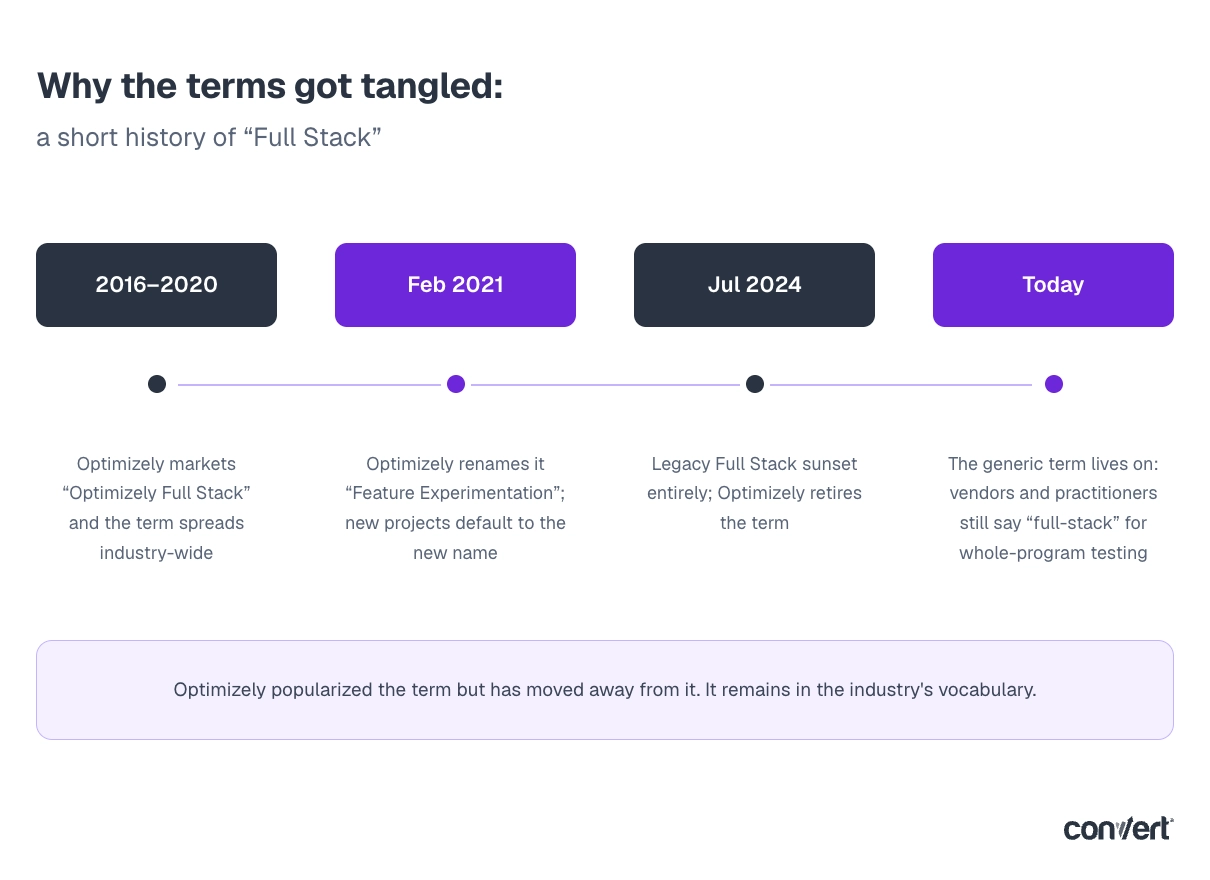
Optimizely popularized “full stack” as a product category in the experimentation sphere. In 2016, it announced Optimizely X Full Stack, a developer product for running server-side experiments in Python, Java, Ruby, and Node. The label stuck for years, and other vendors used it too, Wingify and Convert among them. Then Optimizely moved on; it renamed the product Feature Experimentation in 2021 and retired legacy Full Stack in 2024.
VWO (when it wasn’t the other half of Wingify yet) took a similar route, rebranding its FullStack product as VWO Feature Experimentation. After merging with AB Tasty, the product now goes by Wingify Feature Experimentation.
Even though vendors have since dropped the “full stack” name, the term hasn’t gone away. Teams still say “full-stack” for a testing program that reaches past the browser and “server-side” for how a single test is delivered, and they often use the two interchangeably. Meanwhile, the vendors’ new name has become a category of its own — the feature experimentation platform.
What Is a Feature Experimentation Platform?
A feature experimentation platform combines feature flags with A/B testing. It lets teams release features to a portion of users and measure the impact at the same time. Popular tools in this domain include Convert, Optimizely, Wingify, LaunchDarkly, Kameleoon, PostHog, and more.
The overlap between feature experimentation and full-stack experimentation is large but not absolute. While a feature experimentation platform centers on code-level changes behind flags, a full-stack program does that and also runs client-side tests on web pages.
If a vendor’s feature experimentation product doesn’t run visual web tests, covering the whole stack takes a second tool or a second project type.
The Vendor Decoder
As of October 2026, four well-known vendors sell code-level testing under three names:
| Vendor | Current name | Earlier name | How it’s packaged |
| Optimizely | Feature Experimentation | Full Stack, retired July 2024 | Feature flags with experiments attached |
| Wingify | Wingify Feature Experimentation | VWO FullStack, then VWO Feature Experimentation | Feature flags with experiments attached, inside Wingify’s feature management suite |
| LaunchDarkly | Experimentation | None | Metrics attached to feature flags |
| Convert | Convert Fullstack | None | A Fullstack project type with SDKs, run alongside Web Testing projects |
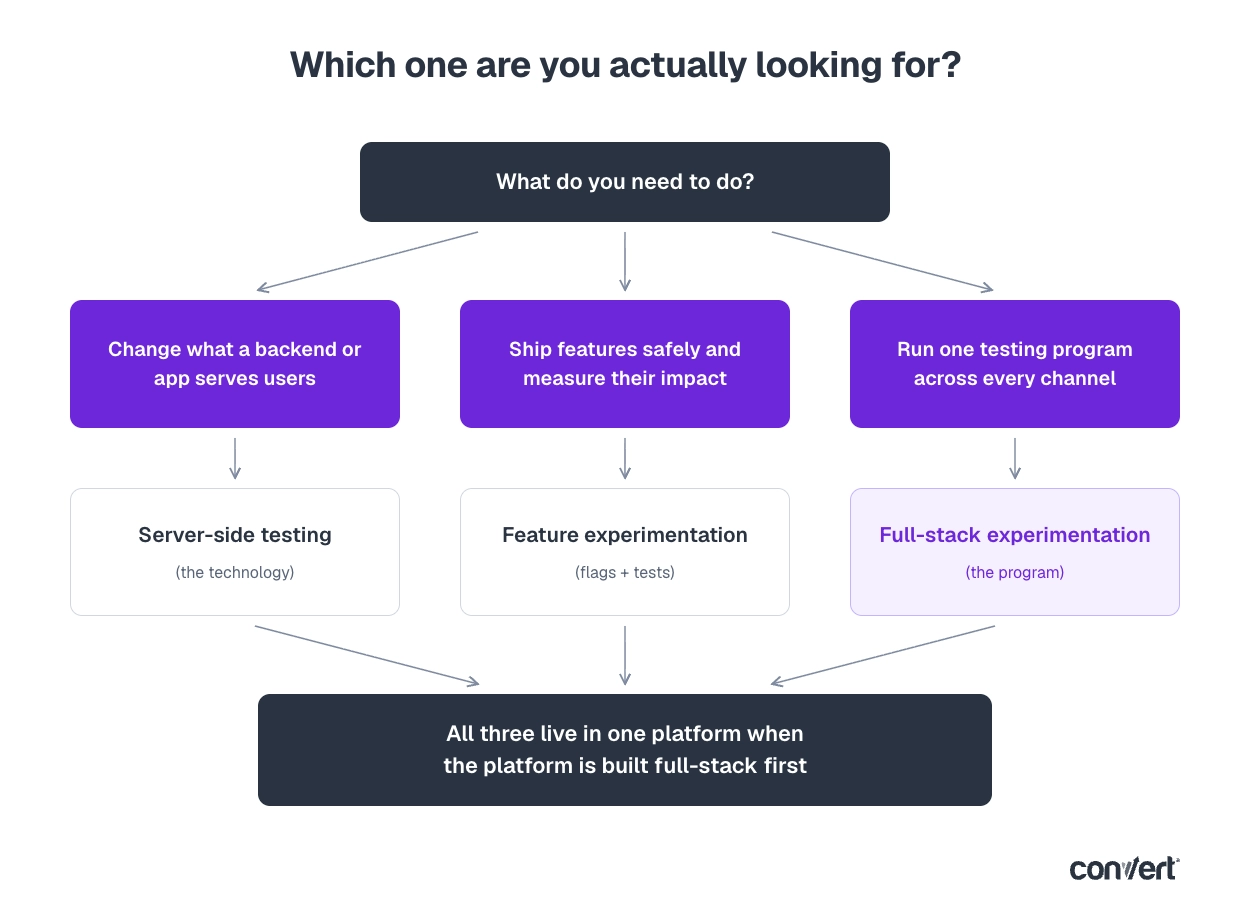
When you write requirements, list the capabilities you need (whether it’s server-side SDKs, feature flags, experiments on flagged features, one visitor ID across channels) and let each vendor map its own label to them.
Learn More: To see how the tools differ beyond their names, compare full-stack testing tools feature by feature.
How Convert Delivers Both Full-Stack and Server-Side Experiments
Convert Experiences runs client-side and server-side testing in one account through two project types.
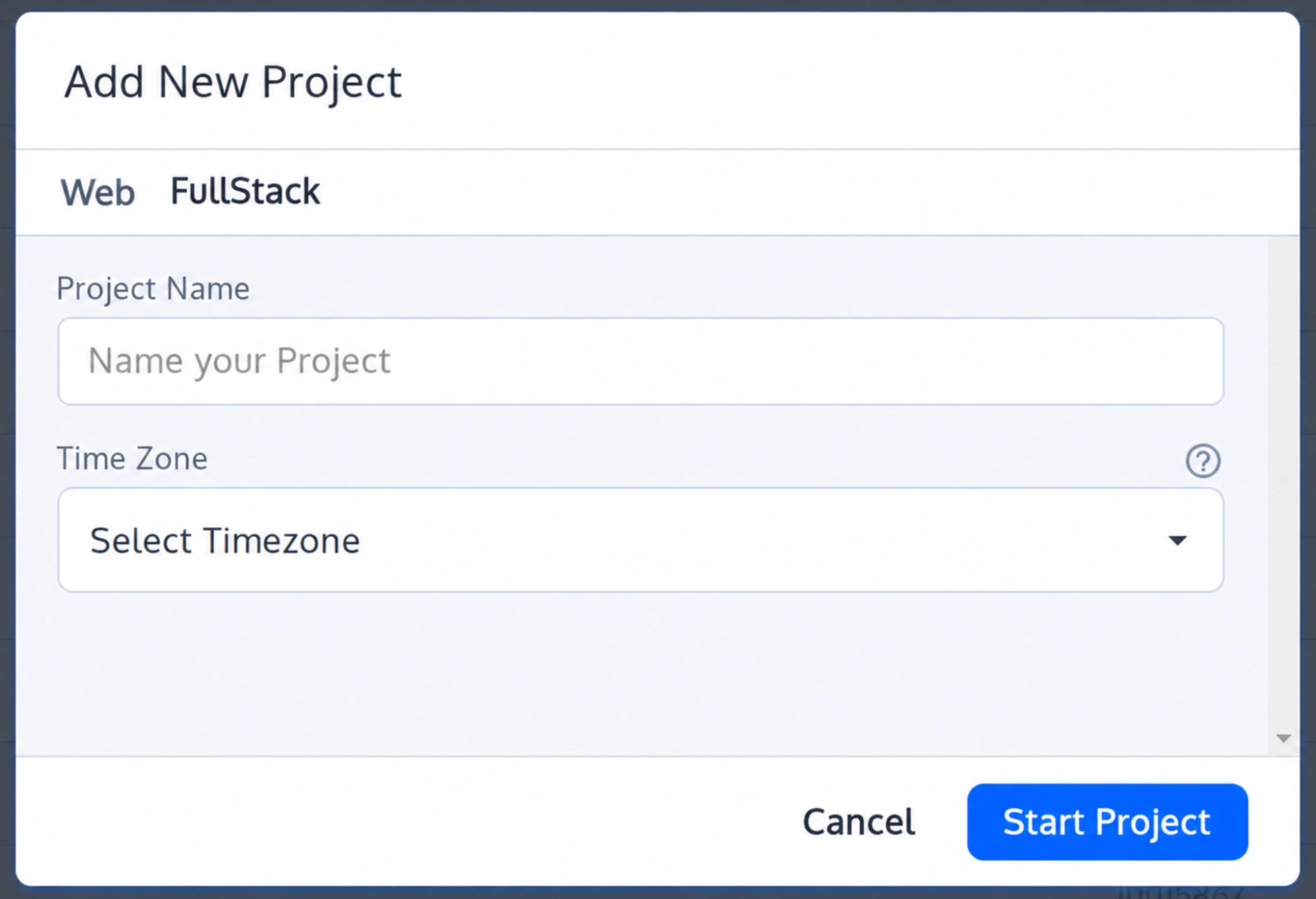
Web testing projects hold client-side tests built in the visual or code editor. FullStack projects hold SDK-based A/B tests and feature rollouts together. Each project type keeps its own reporting dashboard.
The Convert full-stack experimentation tool gives you:
- Six SDKs: As of October 2026, FullStack projects run on SDKs for JavaScript (browser and Node.js), PHP, Python, Ruby, iOS, and Android.
- Local bucketing: Each SDK pulls the project’s settings from Convert’s CDN and keeps a cached copy. Most refresh it on a timer (every 5 minutes by default in the JavaScript, Ruby, and iOS SDKs), while PHP re-fetches when its cache expires, and Python only refreshes in the background if you turn it on. Variation decisions run against that cached copy, so serving a test adds no network call per request. Every SDK runs the same MurmurHash3 calculation on the experience ID plus the visitor ID, so the result is always identical for a given visitor and experiment, no matter which SDK makes the call.
- Same bucketing on every channel: A visitor who sees variation B on your website through the JavaScript SDK sees variation B in your iOS app too, provided both SDKs get the same visitor ID. Convert’s mobile SDKs generate their own ID when none is passed, so send your logged-in user ID to every SDK. Conversions tracked from either SDK then land in the same experience report.
- Data integrity: Defensible experiment results are part of the package too.
- Each goal counts once per visitor per experience by default, and Convert’s servers also deduplicate exposures by visitor and experience.
- The Android and iOS SDKs queue events when a device is offline and fall back to the last cached settings when they can’t load a fresh copy.
- An optional persistent DataStore saves each visitor’s bucketing decision and goal history, so server-side SDKs reuse earlier decisions and don’t double-count conversions across requests.
- FullStack reports carry the same Sample Ratio Mismatch (SRM) check as web tests. SRM check is a chi-square test that flags traffic splits drifting from the plan.
- Performance: In a Cloudflare Worker, the bucketing step takes under 0.1 ms of CPU time, and the JavaScript SDK weighs 24 KB gzipped.

Conclusion
In a nutshell, you use server-side testing when the change lives in code, such as pricing, search, account logic, or a native app. Once your tests reach past the browser into backends, web apps, feature flags, mobile apps, smart TVs, and other channels, you’ve entered the full-stack experimentation domain.
Write your requirements around those capabilities, then it’ll be easier to choose the right vendor regardless of the labels they use.
Frequently Asked Questions: Full-Stack vs Server-Side Experimentation
A team needs server-side delivery when a variation depends on code or data the browser can’t reach. That covers pricing and checkout rules, search and recommendation logic, features gated by plan or login, and screens in native mobile apps.
If building the variation means changing backend code or reading data only the server holds, the test belongs server-side. Changes to copy, layout, and images on web pages can stay client-side.
Companies choose full-stack experimentation when no single delivery method can cover every change they want to test. Server-side testing alone leaves out visual tests that marketers launch without a release, and feature flags for staged rollouts.
A full-stack program brings all three under one set of goals, so a pricing test on the backend and a headline test on a landing page are judged by the same metrics.
An experimentation platform delivers both by pairing a JavaScript snippet for browser tests with SDKs that run inside backends and apps. The two paths share visitor IDs and goal definitions, so one visitor gets one consistent variation, and results can be compared across channels.
In Convert Experiences, client-side tests run in Web Testing projects and SDK tests run in FullStack projects within the same account, each with its own report.
Teams implement server-side experimentation in a SaaS product by installing the testing SDK in the backend and initializing it once per process. Then they pass the logged-in user’s ID as the visitor ID, ask the SDK which variation to serve wherever the code branches, and track conversion goals from the same code.
Convert’s developer docs advise against creating a new SDK instance for every request. They also recommend a persistent DataStore, so bucketing decisions and goal counts carry across requests.
Server-side experimentation needs developers, because every variation is code that goes through review and deployment, plus someone who owns the event tracking.
Full-stack experimentation needs that team and more:
• Marketers or CRO specialists who build client-side tests in a visual editor
• A product owner who manages feature flags and rollouts
• An analyst who keeps goals and metrics consistent across channels
Convert’s developer docs list four common issues with server-side experimentation:
1. The app and the backend use different visitor IDs, so one person lands in two variations.
2. Changing a running test’s traffic split reshuffles returning visitors.
3. Conversions get counted twice when the SDK keeps no state between requests.
4. Events are dropped because of malformed visitor IDs. The tracking server still answers 200 OK, so nothing looks wrong

Written By
Uwemedimo Usa
Conversion Rate Optimization, Conversion Copywriting, B2B SaaS Content Marketing +3 more
Conversion Rate Optimization, Conversion Copywriting, B2B SaaS Content Marketing, A/B Testing Tools Evaluation, Generative Engine Optimization, A/B Testing Statistics Show less
Edited By
Carmen Apostu

Fact-Checked By
Ahmed

How Was This Blog Written
This article was created by Uwemedimo Usa, Content Writer, fact-checked by Ahmed Abbas, Fullstack Developer,...
This article was created by Uwemedimo Usa, Content Writer, fact-checked by Ahmed Abbas, Fullstack Developer, with editorial review by Carmen Apostu.
To develop it, we used the following sources of input:
- Primary sources reviewed: Convert developer documentation on how Convert FullStack works, the bucketing algorithm, server-side experimentation, tracking conversions, moving from the tracking script to an SDK, the persistent DataStore and Cloudflare Workers; Convert support articles on choosing between Web Testing and Fullstack and sample ratio mismatch; Optimizely’s Feature Experimentation migration timeline; Wingify’s FullStack to Feature Experimentation migration guide and September 2026 brand announcement; LaunchDarkly’s Experimentation documentation; VentureBeat’s September 2016 report on Optimizely X; and Google Search Central’s guidance on website testing.
- Internal expertise used: Ahmed Abbas, Fullstack Developer at Convert and Convert’s product documentation
AI assistance was used for: summarizing source notes, outline generation, checking structure, editing for clarity, and checking drafted sentences against source pages for technical accuracy.
AI was not used for: original expert judgment, final recommendations, statistical claims, product claims, source verification, or final editing.
Every factual claim was reviewed by Uwemedimo Usa and Ahmed Abbas. Any claims involving product functionality, statistics, legal/compliance issues, or customer results were checked against Convert’s developer and support documentation.