Feature Flags vs Rollouts vs Feature Testing: What’s the Difference?


- Feature flags switch functionality on or off at runtime, without a deploy.
- Rollouts widen an already-approved feature to a growing percentage of users.
- Feature testing compares variations against a control to find which performs better, using A/B/n testing underneath.
- All three run on feature flags. Only feature testing holds back a control group.
Feature flags are conditional logic in your code that switches functionality on or off at runtime. Rollouts and feature tests both sit on top of flags, which is why the terms blur together in the same conversation.
We’ll clarify all 3 in this article so you’re comfortable using them in product optimization and in your lingo.
What is Full-Stack Experimentation?
Full-stack experimentation is a method of testing changes across the entire technology stack, from user-facing elements to backend systems and infrastructure.
Client-side testing (think of an A/B test comparing two versions of a form header on a landing page) runs in the browser and changes what has already rendered, which suits layout, copy, and visual UX.
Full-stack goes further, touching on deeper functionality like pricing rules, search algorithms, API responses, mobile app flows, and infrastructure changes that only surface under load. Users get bucketed into a variant before the page or app renders, so there’s no flicker while the browser swaps one version for another.
Feature flags are what carry this. You wrap the new behavior in a flag, ship the code with the flag off, then decide separately who sees it and when. Flags, rollouts, and feature tests are three answers to that second question.
In Convert Experiences, flags, rollouts, and feature tests all live in the Full-Stack product, a separate project type from web testing. And it is covered in six SDKs, i.e., JavaScript/TypeScript, PHP, Python, Ruby, iOS, and Android. All six share the same flag, rollout, targeting, and bucketing model, so a visitor is bucketed identically regardless of which one you integrate.
What Are Feature Flags?
A feature flag is conditional logic in your code that turns functionality on or off at runtime, without a deploy. The code ships once, but who sees the feature stays adjustable afterward.
For example, a kill switch on a payments integration can turn a failing third-party dependency off in seconds. And permission gating keeps a feature visible only to accounts on a given plan, and may sit in the codebase for years. Along with these two examples, flags come in categories with very different lifespans. But mixing them up can fill your codebase with dead branches.
In Convert Experiences, your code asks the SDK whether a feature is enabled for a given visitor. The SDK returns the status plus a set of typed variables (boolean, integer, string, or JSON) that your application reads to serve the right experience.
What Are Rollouts?
A rollout widens exposure to a feature you’ve already decided to ship. A typical use case is to release a feature to only 20% of users at first, monitor error rates and guardrails, then move to 50%, and then to everyone.
There are two situations where you’d use a feature rollout:
- De-risking a launch: The feature is built and QA’d, and you want to limit how many people a surprise reaches.
- Widening a winner: A feature test has returned a result, and the rollout ramps up traffic to the winning variation.
In Convert Experiences, a rollout is an experience of type ‘feature_rollout’: one non-original variation, no control. You adjust the exposure percentage from the dashboard, and dialing back to zero doesn’t require you to redeploy.
What Is Feature Testing and How Is It Different From A/B Testing?
Feature testing can mean two things depending on who’s saying it.
In software development, it’s a quality assurance job. In QA, feature testing confirms that a feature works correctly within the application, while in product experimentation, it measures the feature’s impact on user behavior and business metrics.
The product experimentation sense is what this article focuses on. Feature testing compares variations of a feature to see which performs best against a metric you picked in advance. The method underneath is A/B/n testing. What changes is where the experiment runs and who ships it, so a feature test reaches the backend code. But the statistics work the same way.
In Convert Experiences, a feature test is an experience of type ‘a/b_fullstack’: an original plus one or more variations with traffic split between them and evaluated against a goal.
Feature Flags vs Rollouts vs Feature Testing: A Side-by-Side Comparison
Flags, rollouts, and feature tests share the same wiring, so the differences live in what you’re asking and what you get back. If you’re reading this to settle an argument right now, jump to row three.
| Factor | Feature flags | Rollouts |
Feature testing |
||||||||||||||||||||
|---|---|---|---|---|---|---|---|---|---|---|---|---|---|---|---|---|---|---|---|---|---|---|---|
| What it is | Conditional logic your app checks at runtime | A percentage-based exposure ramp | A comparative experiment | ||||||||||||||||||||
| The question it answers | Can this be switched on for this user? | Is it safe to widen exposure? | Does the variation beat the control? | ||||||||||||||||||||
| Is there a control group | No | No | Yes | ||||||||||||||||||||
| How traffic is allocated | On or off, or targeted by attribute | One variation, ramped 20% to 50% to 100% | Split across control and variations, held fixed for the duration | ||||||||||||||||||||
| What counts as a result | Nothing. It’s a switch | Guardrails held and error rates stayed flat | A predetermined metric moved, with statistical significance | ||||||||||||||||||||
| Who operates it | Engineering | Engineering and product together | Product, growth, CRO | ||||||||||||||||||||
| Common failure mode | Flag sprawl and stale logic | Reading exposure as evidence | Underpowered tests and unguarded metrics | ||||||||||||||||||||
| Example | Kill switch on a payments integration | New checkout ramped to 20% of EU traffic after a passing test | Sticky vs non-sticky search bar, measured on task completion | ||||||||||||||||||||
| Convert experience type | N/A, it’s an underlying mechanism, not an experience type | ‘feature_rollout’ | ‘a/b_fullstack’ |
Flags, Rollouts, and Feature Testing: Which One Do You Need?
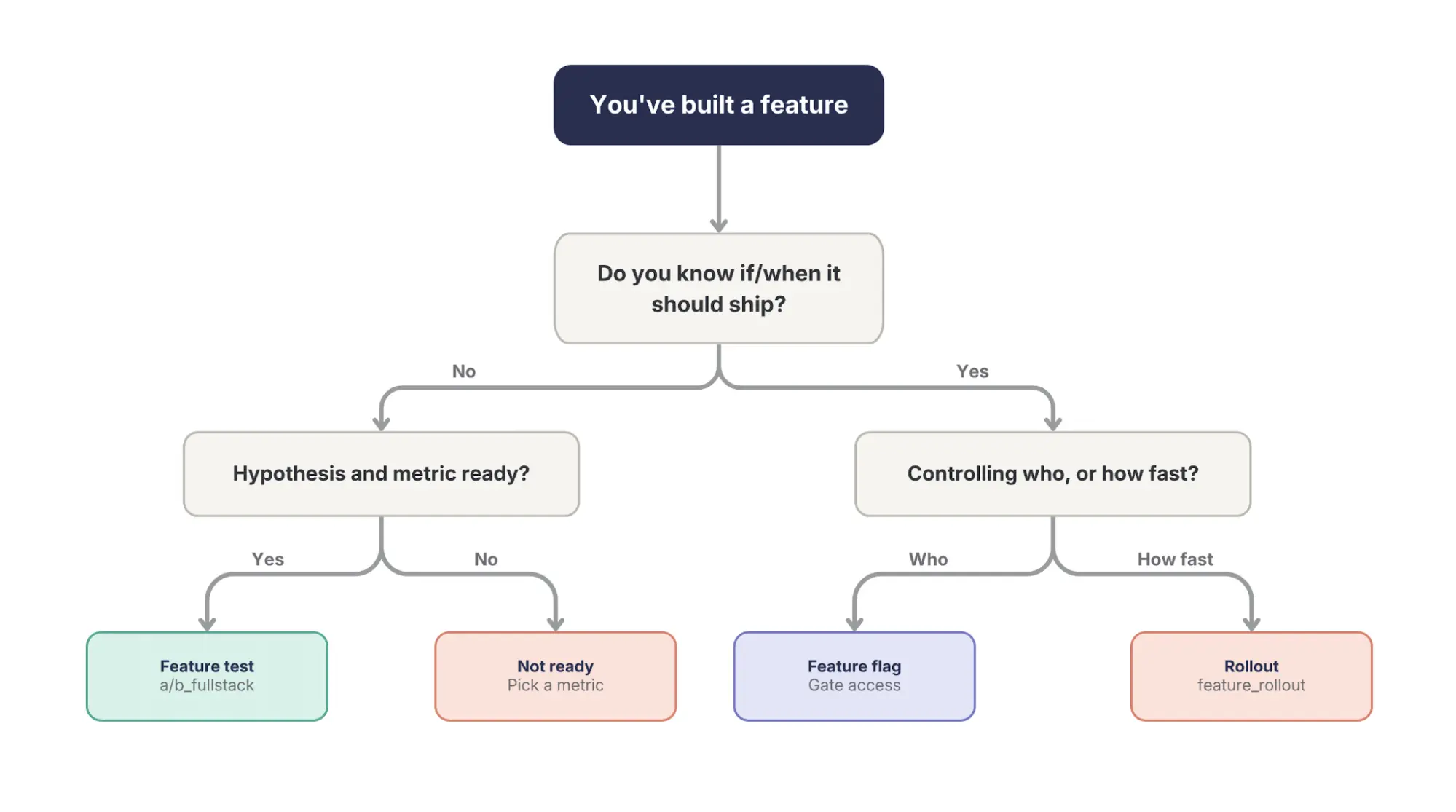
Start with what you already know.
If you know the feature should ship and you’re managing who reaches it, use a flag. You can use a flag to control which users have access to the feature by plan, by region, by internal team, or turn it off entirely when something breaks.
If you know the feature should ship and you’re managing how fast it reaches everyone, use a rollout. The decision is “Yes, let’s ship it”, but the ramp protects you while it lands.
If you don’t know whether the feature should ship, run a feature test. You need a hypothesis, a metric chosen in advance, and a control group that stays unexposed while the test runs.
The three combine more often than they compete. A flag gates the feature during development, a test decides whether it earns a place in the codebase, and a rollout carries the winner to everyone.
In a Nutshell: A Switch, a Dimmer, and a Measuring Scale
Flags, rollouts, and feature testing share the same wiring but serve three different purposes.
The wiring is what a capable full-stack experimentation platform handles for you.
Convert Experiences resolves all three from one full-stack integration, so you can gate a feature by plan or region, ramp a validated release from 20% to 100%, and run a controlled test against a goal metric. Six SDKs cover web, server, and native mobile, with the JavaScript SDK also running in edge environments like Cloudflare Workers. The bucketing stays consistent across all of them.


Written By
Uwemedimo Usa
Conversion Rate Optimization, Conversion Copywriting, B2B SaaS Content Marketing +3 more
Conversion Rate Optimization, Conversion Copywriting, B2B SaaS Content Marketing, A/B Testing Tools Evaluation, Generative Engine Optimization, A/B Testing Statistics Show less
Edited By
Carmen Apostu

Fact-Checked By
Ahmed

How Was This Blog Written
Sources of input: Convert’s developer documentation for the Full-Stack SDK data model and feature-flag API....
Sources of input: Convert’s developer documentation for the Full-Stack SDK data model and feature-flag API. Convert’s own published guides on feature flags and rollouts, and on feature testing in product experimentation. Internal Convert product expertise on how flags, rollouts, and feature tests are configured.
AI disclosure: AI was used for research synthesis across published writing on feature flags, rollouts, and feature testing, for structural scaffolding of the article outline and comparison table, and final editorial checks against internal guidelines. It was not used to generate the published prose. Every sentence was written by the author. Product claims were checked against Convert’s documentation rather than accepted from model output.