Experimentation in Tourism: A Practical Guide for Small Businesses and Solo Growth Professionals



Look up experimentation in tourism, and you’ll find tons of case studies from companies like Booking, Expedia, and Airbnb. These companies run thousands of tests a year on their own platforms, and Booking alone keeps over 1,000 experiments running at any given moment. That paints experimentation as a normal part of running a tourism company.
But that’s not the case. Most companies in this space look nothing like Booking or Airbnb. The tourism industry is made up mostly of smaller operators scattered across the globe, and most of them rarely run experiments—A/B tests least of all.
This handbook digs into that. We’ll break down what the data says about tourism experimentation as a whole and how travel/tourism consumers behave today. We’ve also spoken with experts in the space about how they approach experiments and secure client buy-in.
Why tourism research needs experiments
A 2020 paper, A review of experiments in tourism and hospitality, argues that tourism research relies too heavily on surveys and correlational data. The problem with this self-reported data is that what tourists say doesn’t always match what they do—which is the intention-behavior gap.
What’s missing is data that shows a causal relationship between an intervention and an outcome. To remedy this, the authors recommend natural field experiments that measure how real stakeholders behave in real settings and can establish cause and effect.
For an experiment to prove that intervention X causes outcome Y, four conditions have to hold:
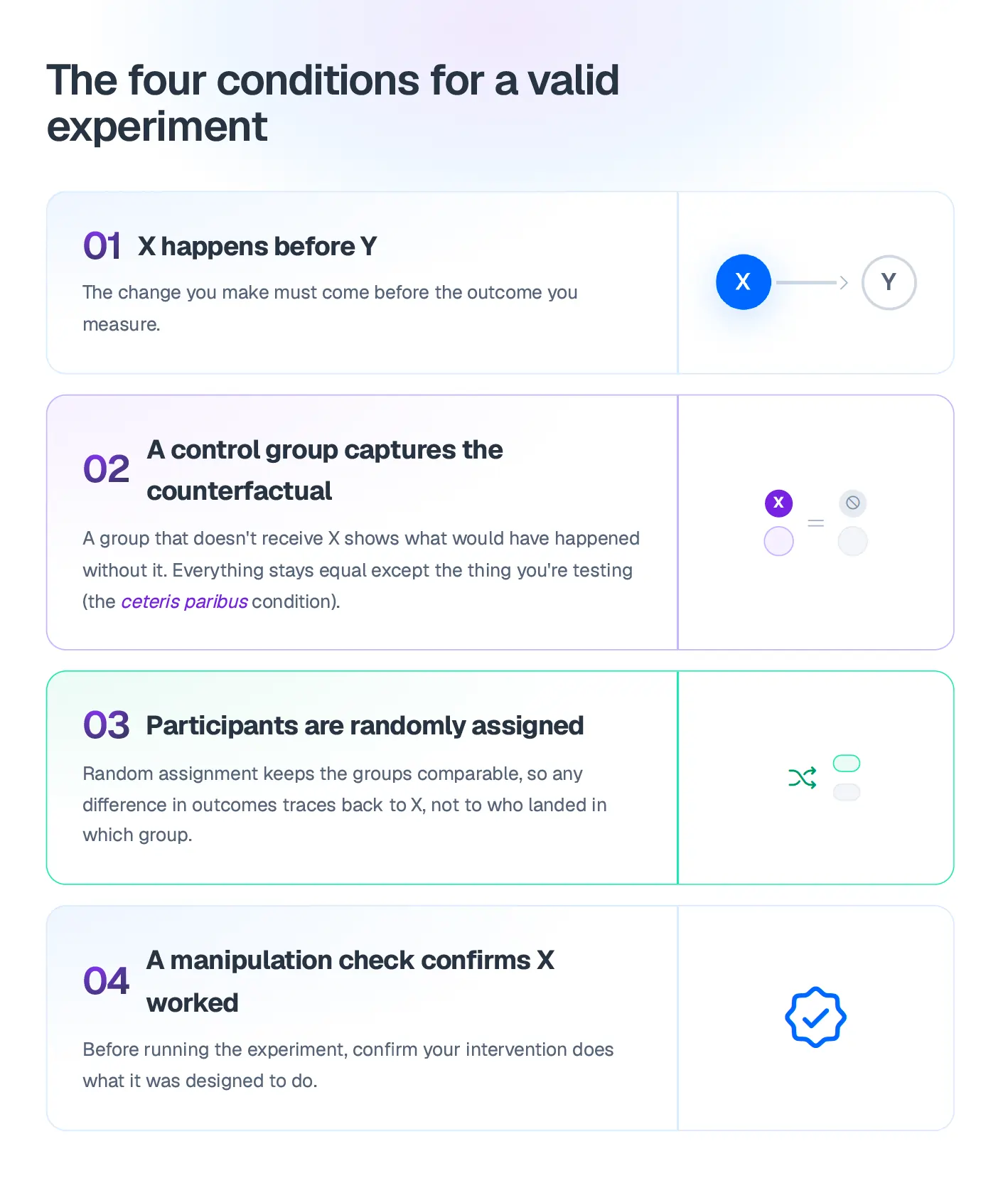
Confounding variables like weather, guest mix, or a local event also have to be anticipated and either controlled for or measured and included in the analysis.
Experiments that meet these conditions are usually run in real-life settings like hotels and tourist attractions, which gives them high external validity. This means that the findings can be generalized to other people, settings, and time periods.
They also produce causal evidence you can use to guide business decisions or policy changes.
The four most common types of experiments in tourism
Tourism and hospitality research tends to fall into four buckets, each with its own trade-off between control and realism:
- Laboratory experiments: The researcher controls everything, so internal validity is high, but the setting is artificial, so external validity is low. They’re best for isolating why an intervention works, not just whether it does.
- Field experiments: These run in real settings with real stakeholders and use actual behavior as the outcome, so external validity is high. Internal validity, however, is lower, because confounding variables are hard to avoid and random assignment often isn’t possible.
- Quasi- and natural experiments: These are used when researchers can’t control X or randomize participants, like in the case of a terrorist attack or the Brexit vote. Internal validity is lower, but for questions like “What does a safety scare do to bookings?” or “How did the policy change shift demand?”, it’s often the go-to.
- Choice experiments: These are survey-based and ask participants to choose between specific product options. Internal validity can be high if designed well, but the external validity is low because the choices are stated rather than acted on.
What these experiments have shown
Here are some real experiments conducted across these four types. Many experiments run in tourism today borrow from the principles these studies established, rather than starting from original VoC or deep quantitative data of their own.
- Images outperform text blocks for carbon offsets
In a 2017 lab study, Babakhani, Ritchie, and Dolnicar examined why only 10% of passengers purchased voluntary carbon offsets when booking flights. Using eye-tracking to measure how travelers responded to different messages, they found that people have low awareness of offsetting schemes and tend to ignore dense blocks of text. Short copy paired with images drew attention and prompted an emotional response, while longer text did not.
- Smaller plates and subtle cues reduce buffet waste by 20%
Steffen Kallbekken and Håkon Sælen’s 2013 field study showed that two simple, nonintrusive nudges—reducing plate size and providing social cues—can reduce food waste at hotel buffets by around 20%.
Offering smaller plates psychologically encourages guests to take smaller portions, while displaying subtle messaging, like reminding guests they can return for more food, keeps them from overloading their plates.
Their findings are significant because they prove that sustainability measures don’t have to come at the expense of profitability or customer experience. By preventing waste, hotels reduce food purchasing and disposal costs while shrinking their environmental footprint. - Terror incidents redirect travelers to safer destinations
Jorge Araña and Carmelo León’s 2008 study looked at how the September 11 attacks in New York reshaped tourist demand for competing destinations in the Mediterranean and the Canary Islands.
They found that terror incidents sharply reduce inbound bookings, since they undermine tourists’ perceptions of safety. Demand doesn’t leave the market entirely, though; travelers often substitute the affected country with an alternative, similar destination they consider safe. - Rural travelers value location, facilities, and price when choosing a stay
In a 2009 discrete choice experiment, Albaladejo-Pina and Díaz-Delfa examined what drives demand for rural accommodations in Spain. They found that tourists place significant value on attributes like property location, available facilities, and price. They also evaluate trade-offs in accommodation features to choose the option that provides the highest overall utility.
Understanding these preferences allows rural tourism operators to adjust what they offer to match consumer expectations.
Why this matters for your own testing
External validity drops whenever there’s a discrepancy between what people say and what they do. For instance, in Karlsson and Dolnicar’s 2016 experiment into whether eco-certification sells tour boat tickets, 60% of passengers said they considered the environment when choosing between two boats, but only 14% could correctly say whether the boat they picked was certified.
This gap between stated and actual choice is why experiments in tourism should measure what people do, not what they say.
How travel and tourism consumers behave in 2026
Knowing what to experiment on starts with understanding how people travel today: what they spend on, what they prioritize, and how they behave on trips.
Travel spending under economic pressure
EY-Parthenon’s 2026 survey of over 1,500 US consumers found that nearly two-thirds think a recession is likely, which is making people more cautious about discretionary spending like travel.
Even so, people aren’t dropping it from their plans. KPMG’s 2026 Summer of Experiences report found that 60% of US consumers planned to travel over the summer, though overall spend has fallen as people take shorter trips and look for cheaper ways to stay.
Travel demand around the world
Outside the United States, travel spending looks a bit different.
American Express’ 2026 Global Travel Trends Report found that 40% of global travelers plan to spend more on travel in 2026 than last year. 74% of Millennials and Gen Z call travel a “non-negotiable” expense, and 64% would take a job with fewer benefits if it gave them more flexibility to travel.
Experiences > material goods
American Express found that 79% of Millennials and Gen Z prefer hands-on activities that connect them to a place and its culture, like a pasta-making session in Bologna or a pottery workshop in Kyoto. The rationale is that a skill or memory outlasts any souvenir.
That logic extends to where they sleep, with 91% open to unconventional accommodation like luxury rail travel or converted historical spaces.
One trip, multiple destinations
Klook’s 2026 Travel Pulse study found that two-thirds of travelers plan to visit more than one destination per trip, a clear move away from the older one-stop pattern. Popular cities like Tokyo or Paris now serve as jumping-off points, where travelers spend a few days before heading to smaller, less familiar locations nearby.
Health and wellness on the road
KPMG found that 37% of Americans have cut back on alcohol, a shift driven mostly by younger travelers (54% of Gen Z and 49% of Millennials, against 25% of boomers). So older travelers will likely fill wine tastings and brewery tours, while younger ones gravitate toward the sober “dry tripping” options more operators now offer.
Young travelers will also likely frequent gyms, yoga studios, and recovery spaces to maintain their physical and mental wellness routines while on a trip.
Before you make changes based on these trends, remember that the results depend on the kind of tourism business you run. What works for a large resort won’t necessarily work for a small tour operator, and vice versa.
The state of experimentation in tourism today
Now that you know the main types of tests historically run in tourism and how travelers behave today, you might be wondering how common experimentation actually is in the industry. The experts we spoke to say it’s rare and varies widely by type of business.
For example, Jono Matla, owner at Impact Conversion, has experience working with local tourism operators to promote New Zealand as a destination. At the time, he found little to no formal experimentation among the operators he worked with, even though small conversion lifts could’ve significantly increased their revenue.
When asked why this was, Jono pointed to a long-term reliance on trade partners like travel agents and inbound tour operators. He mentioned that many hotels sold up to 70% of their stock to these partners at a discount in exchange for guaranteed bookings. They were already making good money that way, so optimizing for direct bookings, which would’ve earned them even more, never became a priority.
Olivia Bedford, who works mainly with hospitality companies across Africa, has a similar experience. According to her, this segment is only starting to catch up with technology, and conversion rate optimization (CRO) is still a brand-new concept.
As she put it, “The idea of redesigning a website is difficult because many tour operators are owned by older people who prioritize creating trips based on their expertise over focusing on the tech side.”
However, Laura Duhommet’s experience runs counter to this. She’s worked with companies like Disneyland Paris and Club Med, both of which had teams doing qualitative research and A/B testing, though the focus differed between them. It’s worth noting that, like Booking.com and Airbnb, Disneyland Paris and Club Med are billion-dollar operators with the funds to run experiments and to staff entire teams for it.
💡 The consensus
Larger companies can afford to run both qualitative and quantitative experiments, while smaller operators tend to focus on curating real-life experiences rather than optimizing their websites for easier bookings and conversions.
Why tourism leans on Voice of Customer research over A/B testing
Viglia and Dolnicar’s 2020 study already established that, among tourism businesses that conduct research, most favor Voice of Customer (VoC) research (which is qualitative) over A/B testing, a quantitative method that establishes cause-and-effect relationships.
Laura Duhommet’s experience at Disneyland Paris partly confirms this. She explained that an entire department there was dedicated to qualitative data, with little focus on quantitative experimentation. There are exceptions, like Club Med, where Laura says the data team used UX analytics, and there was no dedicated department for qualitative data. But generally, the industry tilts qualitative.
The question is: “Why?”
There are a couple of reasons.
1. Tourism sells an experience, not a product
Tourism doesn’t typically sell a physical product; it sells an intangible, highly emotional experience. When a customer’s choice comes down to how memorable and personally enjoyable a trip will be, understanding why customers act the way they do becomes the ultimate competitive advantage.
For example, standard statistical tracking, such as occupancy rates, can’t tell a hotel why a family loved their stay. But qualitative VoC tools, like post-stay open-ended prompts, will encourage the family to explain the exact reasons they loved the hotel and would come back.
2. Motivation is hard to influence on a website
Olivia Bedford, who has run A/B tests with the safari companies she works with, says it’s hard to reach significance in tourism A/B tests because “selling a trip hinges on motivation, which is the hardest thing to influence on a website.”
She’s right. People don’t decide to travel somewhere because they saw a pretty website; they’re motivated by the shared experiences of others. Modern travelers research destinations and accommodations thoroughly through online reviews and social media before booking, and they look at user-generated content like Instagram and TikTok videos to see what a destination actually looks like.
Analyzing VoC data helps tourism businesses keep a pulse on what people are saying online about these locations and what to highlight when courting customers.
3. Customer journeys span many touchpoints
Unlike a simple retail transaction, a vacation involves a fragmented, prolonged customer journey that spans weeks or months. It usually looks something like this:
- Pre-trip: The traveler searches for a destination, navigates booking sites, and selects flight itineraries.
- On-site: They check in, interact with frontline staff, dine, and go on tours.
- Post-trip: They fill out feedback forms, post images, and recommend the destination to others.
VoC frameworks map these specific touchpoints. This allows an airline or hotel chain to pinpoint exactly where a service breakdown happened, whether it was a clunky mobile booking app or a slow check-in desk.
The case for A/B testing
You may be thinking, “If VoC research already helps tourism businesses measure the ‘why’ behind customer behavior and motivation, why should I bother with A/B testing?”
Answer: The intention-behavior gap.
While VoC research is invaluable for identifying what problems exist and why customers feel a certain way, it relies entirely on what people say they’ll do. A/B testing measures what people actually do.
To optimize your tourism business, VoC helps you generate hypotheses, but you need A/B testing to validate them.
- VoC finds the friction; A/B testing proves the fix
VoC is a diagnostic tool. If your VoC data reveals that travelers are abandoning your hotel booking page because the checkout “feels too complicated,” you have a verified customer pain point.
What VoC can’t tell you is how to fix it. Should you reduce the form fields, change the layout, add a progress bar, or introduce a one-click payment option?
A/B testing answers that. You take those four ideas from your team and split-test them against your current page. This gives you concrete, revenue-backed data showing exactly which layout maximizes actual bookings.
- A/B testing helps you overcome the intention-behavior gap
People are notoriously poor at predicting their own future behavior, especially in high-emotion, high-cost sectors like travel. In a VoC focus group, a traveler might sincerely say, “I want to see more eco-friendly resort options during checkout.”
But when you run an A/B test placing an eco-friendly option next to a cheaper, standard one, the data might show that 85% of those same travelers choose the cheaper option. A/B testing ensures you invest capital into features that drive actual revenue, not just social desirability.
- A/B testing helps you mitigate loud-minority bias
Qualitative VoC data is highly susceptible to skewed feedback from the loudest voices in the room. For instance, a hotel might receive five passionate negative reviews about a new digital room-key feature, and the executive team, panicking, considers scrapping it entirely.
Instead of reacting blindly, the better move is to run an A/B test in which 50% of customers are prompted to use the digital key, and 50% use the traditional front-desk check-in. The metrics might reveal that while five people complained, 95% of the test group checked in four minutes faster and rated their arrival experience higher.
A/B testing gives you the statistical guardrails to avoid overcorrecting based on isolated complaints.
- A/B testing helps solve the “preference paradox” in travel
Travelers often want conflicting things at once. They want all-inclusive luxury but also authentic, local, off-the-beaten-path experiences. When asked to choose in a survey, they’ll say “both.”
A/B testing lets you test different marketing narratives on your landing pages to see which converts better in real time. You can pit an imagery-heavy, relaxation-focused page against an activity-heavy, adventure-focused one to see which narrative drives more flight or tour bookings for a specific demographic.
💡 The ultimate synergy
Think of VoC as your compass and A/B testing as your GPS. The compass tells you which direction to walk in (e.g., “Our customers value flexibility in cancellation policies”). The GPS gives you the exact turn-by-turn route to get there fastest (e.g., “Displaying the ‘Free Cancellation’ badge next to the price converts 14% better than displaying it at the bottom of the page”).
Using VoC without A/B testing means you’re guessing at the solutions. Using A/B testing without VoC means you’re guessing at the problems. But together, they form an unbeatable optimization engine.
How to get buy-in to run tourism experiments
Jono Matla told us that travel industry leadership often prioritizes advertising and external partners over website optimization because they see the website as a functional tool rather than a growth engine.
So if you want to run tourism experiments, A/B testing especially, you’ll need to prove the work is worthwhile and can make the company more money.
Selling leadership on Voice of Customer research
VoC research gathers customer feedback through open-ended surveys, user interviews, and social media listening, then pairs it with quantitative metrics like Net Promoter Score (NPS) and satisfaction ratings.
None of it requires analytics data, which makes VoC research lower-stakes for leadership. Olivia Bedford says you can earn their trust by showing them patterns from online discussions about their company, location, or the destinations they promote, and then using those patterns to justify a specific test, like changing a hero image or reworking the headline on a tour page.
For example, you could scrape or copy the last three months of 2- and 3-star reviews for your business and your closest competitor. Categorize the complaints (e.g., 40% mentioned slow airport shuttles, 30% mentioned confusing breakfast pricing), then show your executive, saying:
This is a free VoC sample. Our competitor is losing guests over slow shuttle service, and our own guests are frustrated by our breakfast pricing. A formal VoC program would let us target their weak points in our marketing while fixing our own friction points, so we can take some of their market share.
Or take Jono’s point about tourism operators relying too heavily on trade partners and online travel agencies (OTAs). If your company uses this model and loses money to high commission fees, you could pitch direct bookings, saying:
We spend thousands of dollars monthly on OTAs to acquire first-time guests, but our repeat booking rate is flat. Our analytics show people aren’t re-booking, but doesn’t tell us why. A targeted VoC initiative would uncover exactly what would get them to book directly next time, so we can bypass OTA commissions and increase lifetime value.
The key is to give leadership something tangible in return for a yes.
Selling leadership on A/B testing
Convincing leadership or clients to run A/B tests takes a bit more work because executives don’t care about cleaner layouts or better readability. They care about average order value (AOV) and direct bookings. So you have to frame A/B testing as a revenue-recovery mechanism.
This requires an analytics platform that’s already collecting data.
Jono recommends starting with existing quantitative data like analytics and heatmaps, using it to build a problem-focused case for leadership, then quantifying the upside by showing how much money they can earn with a slight lift in conversions.
Say you run an attraction site with 100,000 monthly visitors, a 2% conversion rate, and a $50 average ticket. That’s $100,000 in monthly revenue. You could tell leadership:
If we use A/B testing to optimize the checkout flow and lift conversion by just 0.3% (from 2.0% to 2.3%), we generate an extra $15,000 a month on the same marketing spend. That’s $180,000 over the next year. A/B testing practically pays for itself.
Or, if your cart abandonment rate is high, you could pitch A/B testing as a way to address it. For example, you could say:
Our data shows that thousands of travelers add a tour/room to their cart but leave when they see the taxes and fees screen. Instead of redesigning the whole site, we want to run a low-risk A/B test. Group A sees the fees at the very end; Group B sees them bundled upfront. We’ll let the data decide how to present pricing to maximize completed checkouts.
The best way to get buy-in here is for executives to see exactly how A/B testing increases the business’s profitability.
What makes A/B testing in tourism different
Because tourism businesses sell experiences rather than just tangible products, A/B testing in this industry subverts the standard rulebook. Here are three ways A/B testing in tourism differs from the norm.
Friction can help your conversions
In standard A/B testing, the goal is usually to make the process smoother, e.g., help users sign in and check out faster, find information quicker, and so on. Experimenters try to remove as much friction as they can. But in tourism, friction can sometimes work in your favor.
Ryan Thomas, co-founder at Koalative, told us about a client whose product was a home-exchange platform, where you make your home available to earn credits, and use those credits to stay in other members’ homes.
Ryan wanted more people to sign up, so he ran a test that simply showed visitors the available homes, on the hypothesis that seeing the properties would build an emotional connection and the willingness to join. But it backfired.
Looking at the properties alone didn’t help people understand how the platform worked. What worked better was adding friction: a sign-up process that walked people through how the product worked before showing them homes. Product education had to come before desire. In fact, education is what created the desire.
Jono Matla had a similar experience with a booking-engine test. When he tested a new, more intuitive engine, the results were inconclusive, which he attributed in part to users having such high intent that they would tolerate some friction to complete a purchase. It’s like booking a trip to Disneyland: even if ads on the checkout page get in the way, you’ll still see the booking through.
For your own testing, this means you shouldn’t assume less friction always wins. When a purchase requires understanding or carries high intent, a smoother path can cost you comprehension or do nothing at all. Test whether friction is hurting you before you remove it.
Aspiration and conversion work in tandem
For tourism businesses, the online experience and the offline reality aren’t separate; they go hand in hand. So, when you A/B test, it helps to run tests that account for both.
Laura Duhommet explained that at Disneyland Paris and Club Med, she had to make people “dream” before checkout, and that shaped the tests she ran.
Both companies tested heavily on microcopy and product-page content. For example, should a page use video or high-quality images? Since the customer already intends to book, the question was which visual would turn them from a browser into a paying customer. That’s what those tests answered.
However, reeling customers in with the promise of luxury is one thing; following through is another. You don’t want guests arriving at the hotel, safari, or resort only to find that what they were promised isn’t what they got. This is why Jono recommends applying optimization across every touchpoint in the customer journey, from the website to the physical experience itself.
Optimizing the physical experience means treating the offline moments as testable steps too, like timing the airport pickup, simplifying check-in, reworking how a tour guide opens the day, or adjusting how dinner reservations are handled. You then collect post-experience feedback and let it inform improvements, which completes the cycle of A/B testing.
Localization can make or break a test
Travel is inherently cross-border, but booking behavior is deeply regional. If you run a global web experiment without localizing it, your results will mask reality, since what delights a traveler in New York might alienate one in Tokyo. So, before you test, understand the purchase behavior and mindset of people in the specific markets you’re targeting.
For example, when Olivia runs A/B tests for safari companies targeting UK audiences, she uses a health-and-safety framing based on her own understanding of the UK market, as she’s from that region herself. She highlights things like fenced lodges, malaria-free areas, and child safety in open vehicles. The US market, on the other hand, is more aspirational and less safety-anxious, so the same copy wouldn’t land.
Ryan saw something similar when he tested a short quiz at the entry point of the home-exchange platform, meant to tailor the experience to each user. The quiz performed well in most regions but had the opposite effect in some European countries.
Laura found the same pattern at Disneyland Paris. Testing revealed that Spanish visitors took much longer to understand the dining options, indicating a need for country-specific content. She also saw different results when comparing price-per-person versus price-per-night models across French, German, and English users.
The takeaway: Don’t assume a winning test will perform the same way everywhere. Beyond translating languages, you also have to factor in what travelers in a given market care about, how quickly they grasp your offer, and how they want pricing framed.
What this means for your tourism business
Historically, most tourism research has relied on surveys, which don’t reliably capture what travelers actually do. On top of that, most tourism businesses are small, and they tend to invest their money into curating great real-life experiences rather than optimizing their websites.
However, the experts we spoke to make a strong case for experimentation—A/B testing in particular. Done well, it helps tourism businesses optimize their websites (and apps) for more bookings, increase revenue, and shape their offerings around what customers expect, think, and do.
While A/B testing isn’t mainstream in tourism yet, Jono and Olivia both say that’s changing, and that operators around the world are starting to catch up with CRO. So if you want to run A/B tests for your own business, Convert can help
With Convert, you can build and launch A/B tests without heavy engineering, run them across your website, and use built-in heatmaps to see where visitors click, tap, and drop off. You also get straightforward reporting that shows which changes increase bookings and which don’t.
If you’d like to get started, sign up for a free trial of Convert, no credit card required.

Written By
Althea Storm, Trina Moitra
B2B SaaS Writing, A/B Testing, A/B Test Duration +4 more
B2B SaaS Writing, A/B Testing, A/B Test Duration, Shopify Conversion Optimization, Experimentation in Tourism, Personalization for Lean B2B Teams, Experimentation Industry Analysis Show less
A/B Testing, Conversion Rate Optimization, Experimentation Program Strategy +3 more
A/B Testing, Conversion Rate Optimization, Experimentation Program Strategy, B2B SaaS Marketing, Brand Positioning, A/B Testing Tools Evaluation Show less
Edited By
Carmen Apostu

How Was This Blog Written
This article was created by Althea Storm, Content Writer and Trina Moitra, CMO, with editorial...
This article was created by Althea Storm, Content Writer and Trina Moitra, CMO, with editorial review by Carmen Apostu, Head of Content.
To develop it, we used the following sources of input:
- Interviews with: Jono Matla, Owner at Impact Conversion, Olivia Bedford, co-founder at WildHire, Ryan Thomas, co-founder at Koalatative, and Laura Duhommet, Lead CRO at Carrefour
- Primary sources reviewed: Research papers, subject matter expert interviews
- AI assistance was used for: Summarizing research papers, organizing SME insights, and headline alternatives
AI was not used for: Original expert judgment, statistical claims, source verification, SME insight extraction, content writing, final editorial approval, and final recommendations
Every factual claim was reviewed by Carmen Apostu, Althea Storm, Trina Moitra, Jono Matla, Olivia Bedford, Ryan Thomas, and Laura Duhommet.