

Combined Results:
| Metric | Client | Lift |
|||||||||||||||
|---|---|---|---|---|---|---|---|---|---|---|---|---|---|---|---|---|---|
| User Progression to “Get a Quote” | Client A | +32.14% | |||||||||||||||
| “Get Registered” Progression | Client B | +1.53% | |||||||||||||||
| Hero Agent Login Click Rate | Client B | +5.22% | |||||||||||||||
| Product Page Progression | Client B | +2% | |||||||||||||||
The Push & Pull of Optimizing for Regulated Industries: Why This Case Study Matters?
Insurance is one of the hardest verticals to optimize. Not because the traffic isn’t there, because the information has to be there.
Most industries improve conversion rates by stripping away content, shortening pages, and reducing cognitive load. Insurance can’t.
The information is load-bearing — it builds trust, qualifies prospects, and in many cases is required by regulatory frameworks.
This creates a UX tension: the same content that makes a prospect trust you enough to convert is also the content that overwhelms them enough to leave.
Both of OuterBox’s clients (let’s call them A and B) were experiencing this tension. They had high-traffic entry pages where users were arriving, browsing, and then… not progressing.
Not bouncing immediately, but also not moving deeper into the funnel toward building quotes, appointments, or agent logins.
In working on these projects, OuterBox applied decades of experience to hit the Goldilock’s sweet spot — retaining the specifics needed to nudge micro-commitments, in an uncluttered, intuitive interface.
Client A: Specialized Insurance Provider:
When Coverage Options Don’t Lead to Quotes
This OuterBox client connects agents and brokers with commercial property and casualty solutions – private flood, mini-wind, deductible buy-back, and manufactured home insurance.
Their website’s primary conversion pathway runs from a high-traffic “Coverages” page to individual product pages, and then to a build-a-quote form.
The Problem
The Coverages page was getting traffic but failing to move users forward.
People scanned the page, didn’t get the clarity they needed to self-select, and left without progressing to a quote.
What OuterBox Found
OuterBox’s CRO team benchmarked the existing page and identified the core issue: the page relied on small icons and minimal text to represent complex insurance products. Prospects needed more information — not less — but organized in a way that guided rather than overwhelmed.
The Redesign:
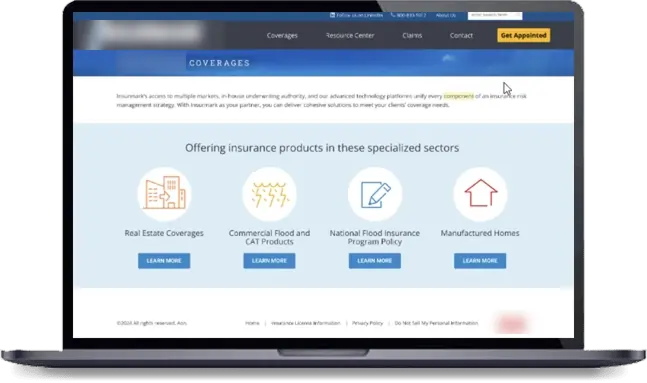
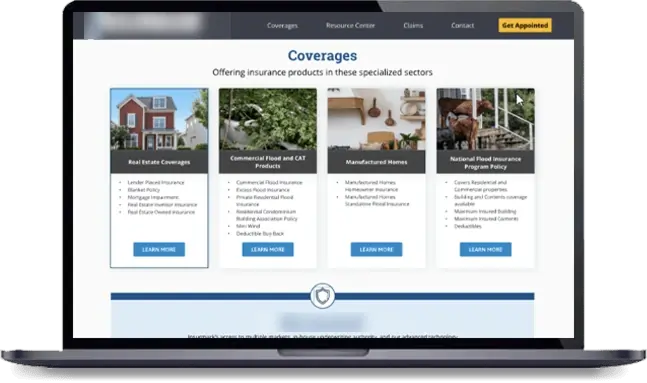
The variant made three structural changes:
- Visual product previews replaced abstract icons. Each coverage category got a real image and expanded bullet-point descriptions that previewed what the user would find on the product landing page.
- The page title was simplified. The variant used a clean “Coverages” heading with a short subhead, reducing the cognitive cost of landing on the page.
- A “Why Client” section was added. For prospects entering through search or referral, the brand was unfamiliar. Adding a value proposition section addressed the trust gap that information-dense industries often create – where a prospect trusts the information but doesn’t yet trust the company providing it.
The Test
OuterBox ran a four-week A/B test, serving the control and variant to 100% of site traffic (split 50/50) across all device types. Custom URL tracking measured user progression from the Coverages page to individual “Get a Quote” product pages.
The Result
The variant drove a 32.14% increase in user progression to the “Get a Quote” page.
Client B: Private Flood Insurance Provider
When the Homepage Can’t Decide What It Is
This OuterBox client provides private flood insurance options for residential and commercial properties, trusted by over 3,000 lenders. They joined OuterBox in 2020 and turned to CRO services in 2024 to address their homepage performance.
The Problem
The homepage had a common B2B insurance problem: it was trying to serve too many audiences with one page.
Brokers needed to find their product.
Agents needed to log in.
New prospects needed to understand the value proposition.
The existing homepage laid all of this out, but without a visual hierarchy that told each audience where to go.
The Redesign:
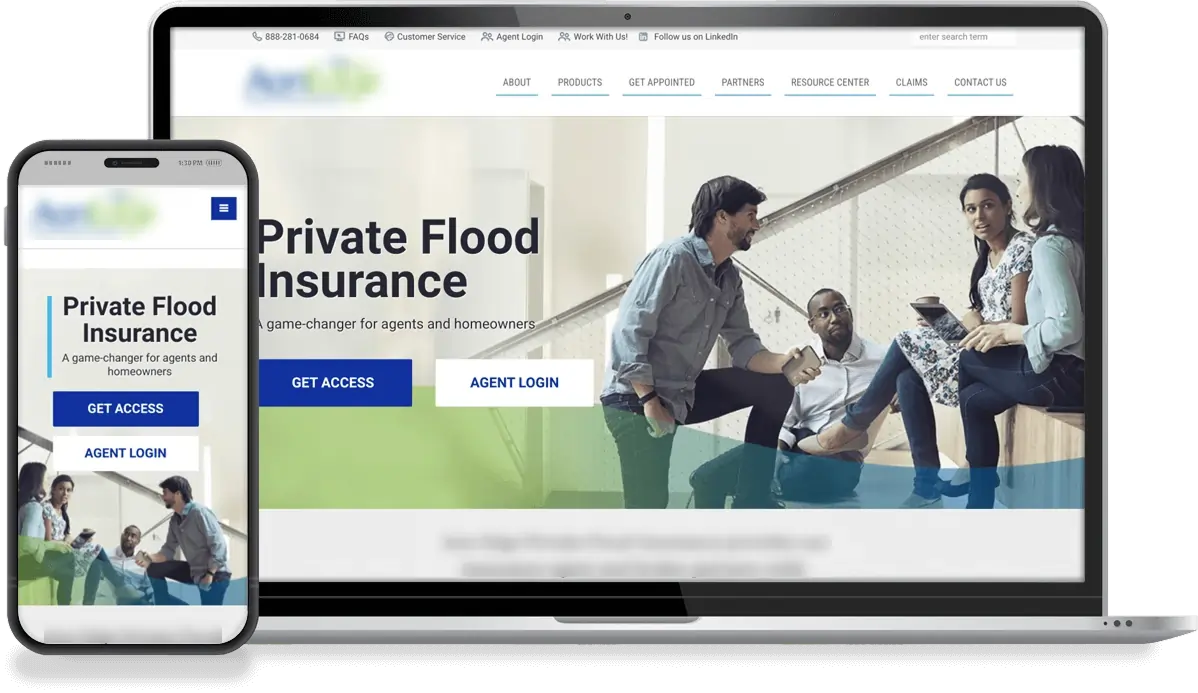
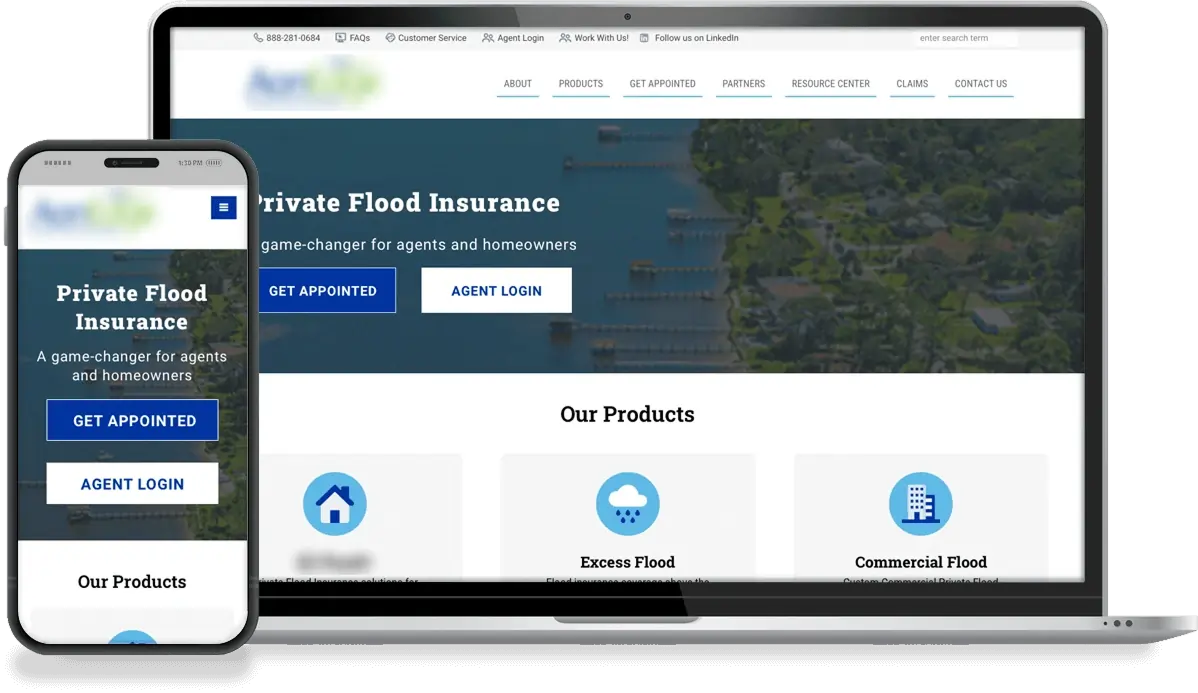
The variant restructured the homepage around distinct user intents:
- A refreshed hero section prioritized content over stock imagery, with a clear CTA that gave arriving visitors an immediate action path rather than asking them to scroll and discover one.
- A new “Our Products” section introduced clickable product cards — giving each insurance category (residential flood, commercial flood, etc.) its own entry point.
- Client testimonials were added — a trust element that the original homepage lacked entirely. In an industry where the product is essentially a promise, social proof is non-negotiable.
The Test
OuterBox ran a four-week split test serving 100% of visitors to either the original or variant homepage across all devices. The team tracked user progression to product pages, agent appointment pages, and login areas.
The Results
| Metric | Lift |
||||||||||
|---|---|---|---|---|---|---|---|---|---|---|---|
| Product Page Progression (all categories) | +2% | ||||||||||
| “Get Registered” Progression | +1.53% | ||||||||||
| Hero Agent Login Click Rate | +5.22% |
The Pattern: OuterBox’s Progression-Based UX Testing Framework
- Research & Hypothesis. Both projects started by benchmarking the current experience — heatmaps, analytics, progression rate analysis — on pages that already displayed high intent.
- Design. Both variants were designed for desktop and mobile simultaneously, with changes rooted in information hierarchy. The question wasn’t “does this look better?” but “does this guide users to their next step more effectively?”
- Test. Both used controlled A/B experiments with 100% traffic allocation, split 50/50, running for approximately four weeks. The North Star Metric (NSM) was progression deeper into the funnel, instead of vanity element clicks.
- Conclusion & Iterate. Winning variants got implemented. Inconclusive or losing results were refined and retested.
Why Convert Was the Platform for This Work:
Insurance companies handle sensitive personal and financial data. The testing platform running on their websites is part of their compliance surface.
OuterBox chose Convert Experiences for these engagements for a specific reason: Convert is both ISO 27001 certified and SOC 2 Type II compliant.
- It is also GDPR-ready & CCPA-ready.
- It uses only first-party cookies and does not store any PII in the default mode
- Data anonymization prevents accidental spillage of meaningful markers and labels to the outside world
- Data segregation allows companies to further reinforce the security of how enterprise data is stored by Convert
- Consent mode — where you can delay cookie writing & data collection til consent is explicitly provided
- Change History and a clear trail of who has adjusted what, which in conjunction with user permission levels, brings transparency and control to busy optimization programs
“Running CRO tests in regulated industries, like insurance, demands strict compliance and data privacy. That’s why we use Convert: it offers statistical rigor and privacy by design, eliminating ongoing compliance worries. This lets us move faster, gain insights sooner, and clearly demonstrate ROI, removing friction that would otherwise slow projects down.”
Holland Grose, Associate Director, UX/UI Design
What This Means for Insurance Companies Considering CRO:
- The conversion rate of the insurance industry sits at 18.2%
- This is 119% more than the conversion rate of financial services
- Most industries underperform on mobile; Insurance is the exception
- Social media traffic converts unusually well for Insurance
Progression rate is the right metric, not bounce rate
Insurance websites attract intent. This is evidenced by the high average conversion rate across devices. The challenge then is to focus on improving this intent through proof-first confidence-building that gets interested individuals to actually take the next step — browse.
While this may be the eventual goal of all websites, each visitor lost here carries a much higher conversion potential. TL;DR: Insurance traffic is valuable. CRO is non-negotiable.
Design for websites & mobile
Don’t treat mobile properties as an afterthought. OuterBox always runs tests across all relevant devices for a vertical/industry. PRO-TIP: Understanding segment-wise behavior in broader test data is a super-power. It hides a wealth of insights to influence future A/B test ideation and can reveal blind spots.
Story-telling is an underrated leverage
If you review the changes OuterBox made to the two websites using their framework, one thing becomes clear. The “why” is emphasized. Be it in USP sections, in landing page preview bullet-points, or in customer testimonials. When you don’t have the luxury of saying less (because of regulations & compliance needs), you can organize existing elements to tell a story instead.
Stories hook. They are excellent at turning mounds of information into easier self-qualification.
At OuterBox, we believe growth is oxygen. Since 2004, we’ve partnered with B2B and B2C brands to drive measurable revenue through performance marketing — from SEO and paid media to web development, CRO, and analytics. Our approach blends strategy, expertise, and genuine care for the businesses and people we serve. The result? Results-driven digital marketing backed by a people-first culture that fuels long-term success.
Convert Experiences is the preferred A/B testing & personalization tool for lean growth & marketing teams, CRO agencies, and brands in tightly-regulated industries like insurance. GDPR-compliant, CCPA-ready, ISO 27001 and SOC-2 certified, it offers easy consent management, only first-party cookies, in-app warnings to maintain privacy, anonymization, data segregation and more at publicly-listed, affordable prices.