Testing Mind Map Series: How to Think Like a CRO Pro, Part 99 with Christin Müller


Christin Müller is the latest expert to open up their playbook for our Testing Mind Map series. These interviews look past the tidy version of experimentation and into the day-to-day: how evidence fares against conviction, which test wins survive contact with production, and where judgment sits now that AI has commoditized execution.
Christin, tell us about yourself. What inspired you to get into testing & optimization?
I actually got into experimentation more or less by accident. During my studies, I had a Web Analytics course and gave a presentation on Google Optimize. That was my first real touchpoint with A/B testing.
After graduating, I came across a CRO role and realised experimentation could actually be a discipline in itself. I gave it a try and quickly found that I really enjoyed the mix of data, user behaviour, creativity and strategy.
Today, I’m a Senior Consultant at Up Reply, focusing on experimentation, personalisation and conversion optimisation.
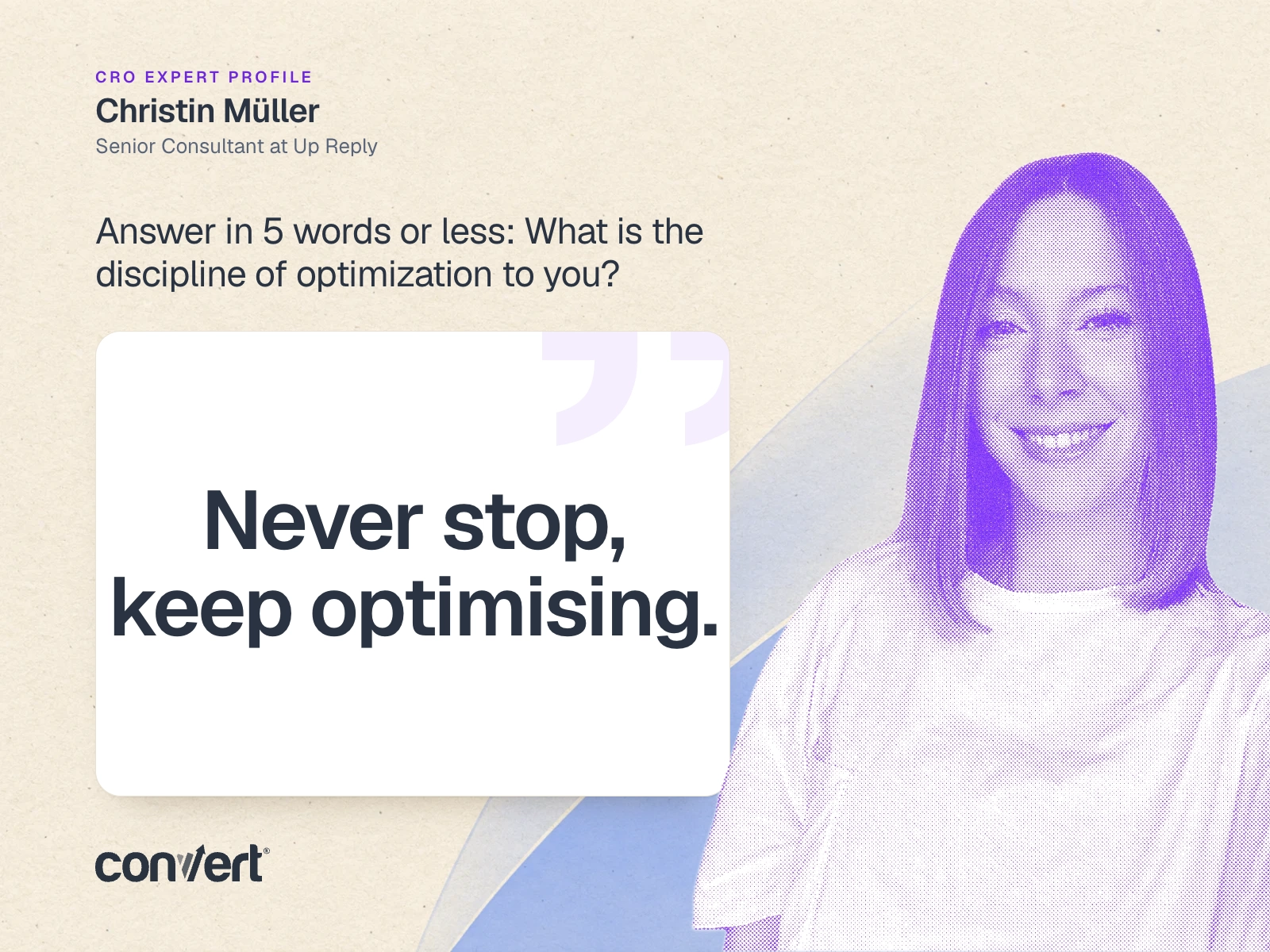
Answer in 5 words or less: What is the discipline of optimization to you?
Never stop, keep optimising
How is AI influencing experimentation for you? How do you think about incorporating AI in your workflows?
At the moment, I am mainly trying to integrate AI into smaller parts of my day-to-day work rather than treating it as one big separate thing. But honestly, that is just the beginning. I see AI as a door opener into a completely new era of experimentation.
It helps me a lot with communication, for example, adapting the same message to different stakeholders and making sure we are speaking the same language.
At the same time, it can be challenging at first because you’re used to doing things in a certain way and often already know what kind of output you want. It takes some trial and error, but once you find the right use cases, it can save a lot of time.
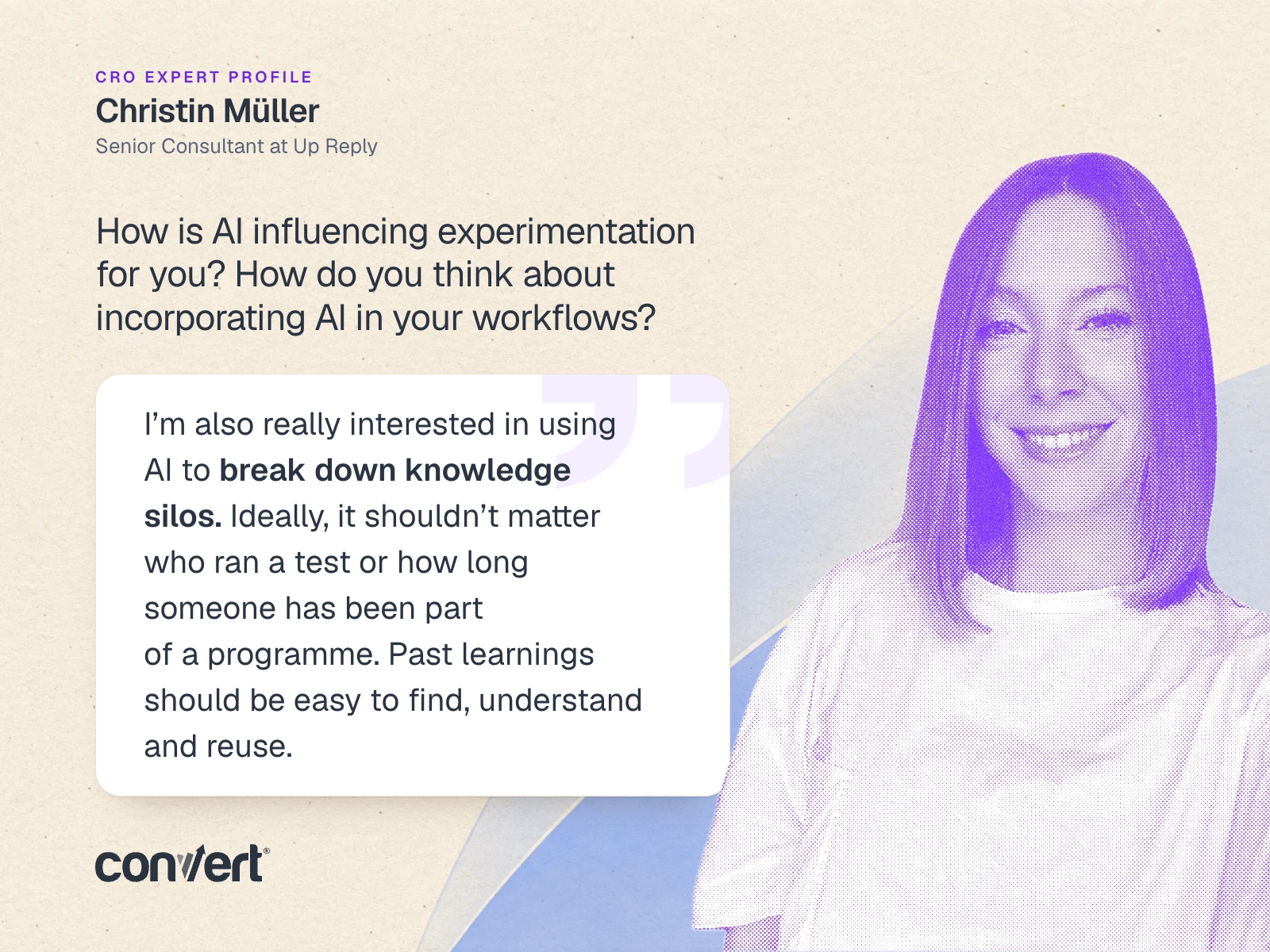
I’m also really interested in using AI to break down knowledge silos. Ideally, it shouldn’t matter who ran a test or how long someone has been part of a programme. Past learnings should be easy to find, understand and reuse. Together with colleagues, I am already actively building towards that, thinking connected workflows and a CRO hub that links insights, hypotheses and experiment design across programmes.
But let’s see how we can connect all those steps into a flow and maybe a kind of AI buddy.
Where are CRO & experimentation headed? And why? How can practitioners adjust?
I think experimentation will become much more connected to business decision-making and go beyond just optimising individual parts of a website.
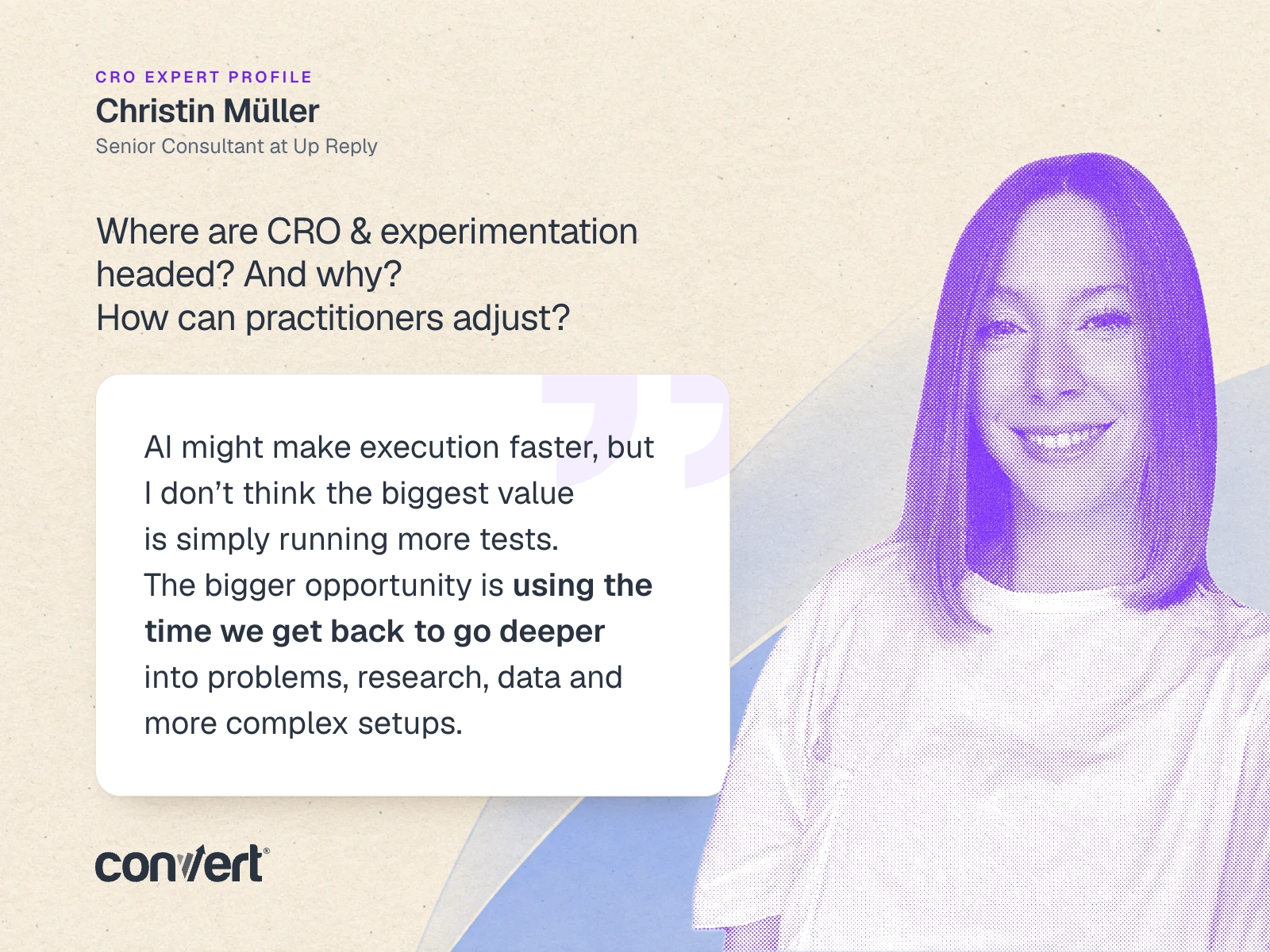
AI might make execution faster, but I don’t think the biggest value is simply running more tests. The bigger opportunity is using the time we get back to go deeper into problems, research, data and more complex setups. I also think quality and knowledge management will become even more important. We need to connect learnings, challenge both AI output and our own assumptions, and pay more attention to what doesn’t work, not just the winners.
Personally, I’m also very interested in full-journey approaches and understanding how different user groups behave across touchpoints.
Talk to us about the unique experiments you’ve run over the years.
What I find most interesting are experiments where the result really challenges your assumptions. Of course, winners are great, but I’ve also worked on tests where everyone was quite convinced a solution would work and then it had little or no significant impact. Those are often the tests you learn the most from, because they force you to look at the problem again and ask whether you were solving the right thing in the first place.
I also really enjoy more complex, full-journey experiments. For example, looking not only at one interaction, but at how different user groups behave across several touchpoints and whether those patterns match the personas or assumptions you started with. That can then lead to much more interesting follow-up questions around personalisation and communication.
Last but not least, AI taking over repetitive tasks and simplifying execution. How has that changed the way you describe work?
For me, the biggest benefit is the time it gives back. Repetitive tasks can take up a lot of time, and AI can create more space for the parts of the job I find most valuable: research, problem-solving, developing new ideas, improving processes and increasing experiment quality.
So I don’t think AI changes the purpose of the work. It gives us more time to focus on the parts that need judgement, curiosity and deeper thinking.
Cheers for reading! If you’ve caught the CRO bug… you’re in good company here. Be sure to check back often, we have fresh interviews dropping twice a month.
And if you’re in the mood for a binge read, have a gander at our earlier interviews with Gursimran Gujral, Haley Carpenter, Rishi Rawat, Sina Fak, Eden Bidani, Jakub Linowski, Shiva Manjunath, Deborah O’Malley, Andra Baragan, Rich Page, Ruben de Boer, Abi Hough, Alex Birkett, John Ostrowski, Ryan Levander, Ryan Thomas, Bhavik Patel, Siobhan Solberg, Tim Mehta, Rommil Santiago, Steph Le Prevost, Nils Koppelmann, Danielle Schwolow, Kevin Szpak, Marianne Stjernvall, Christoph Böcker, Max Bradley, Samuel Hess, Riccardo Vandra, Lukas Petrauskas, Gabriela Florea, Sean Clanchy, Ryan Webb, Tracy Laranjo, Lucia van den Brink, LeAnn Reyes, Lucrezia Platé, Daniel Jones, May Chin, Kyle Hearnshaw, Gerda Vogt-Thomas, Melanie Kyrklund, Sahil Patel, Lucas Vos, David Sanchez del Real, Oliver Kenyon, David Stepien, Maria Luiza de Lange, Callum Dreniw, Shirley Lee, Rúben Marinheiro, Lorik Mullaademi, Sergio Simarro Villalba, Georgiana Hunter-Cozens, Asmir Muminovic, Edd Saunders, Marc Uitterhoeve, Zander Aycock, Eduardo Marconi Pinheiro Lima, Linda Bustos, Marouscha Dorenbos, Cristina Molina, Tim Donets, Jarrah Hemmant, Cristina Giorgetti, Tom van den Berg, Tyler Hudson, Oliver West, Brian Poe, Carlos Trujillo, Eddie Aguilar, Matt Tilling, Jake Sapirstein, Nils Stotz, Hannah Davis, Jon Crowder, Mike Fawcett, Greg Wendel, Sadie Neve, Cristina McGuire, Richard Joe, Ruud van der Veer, Merritt Aho, Felipe Henrique Fogarolli, Riccardo Oricchio, Bruno Borges, Daniel Mullins, Matthew Bass, Pieter Boonstra, Simbar Dube, Dzifa Mensah, Katie Faulkner, Andrea Bronzini, Sanne Maach Abrahamsson, Craig Kistler, Buse Hizarci, David Dias Rodríguez, and Delphine Finders-Binje.

Written By
Christin Müller
Edited By
Carmen Apostu